


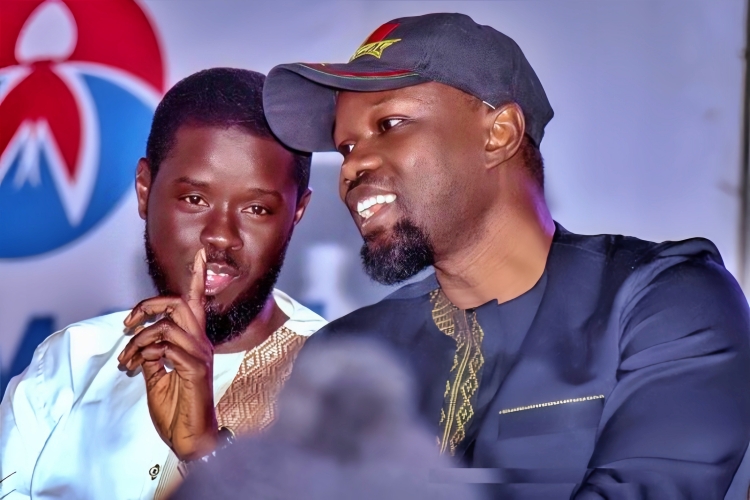
Gambiaj.com – (DAKAR, Senegal) – The power struggle at the top of Senegal’s leadership appears to have spilled into the National Assembly, where the Executive has mounted stiff resistance to constitutional amendments championed by the ruling Pastef parliamentary majority that would significantly curtail presidential powers.
What began as deliberations in the National Assembly’s Law Commission on Wednesday quickly evolved into a high-stakes institutional confrontation, exposing deep divisions within the country’s governing establishment ahead of a scheduled vote on June 29.
At the heart of the dispute is a series of reforms proposed by Pastef lawmakers aimed at redefining the balance of power within Senegal’s political system.
Most notably, the parliamentary majority is seeking to prohibit the President of the Republic from simultaneously serving as the leader of a political party or political coalition, a move that would strip the presidency of one of its most influential political levers.
The proposal is widely seen as part of a broader effort by the Pastef-controlled legislature to reduce the concentration of power in the presidency and strengthen institutional checks on the executive branch.
However, the government has drawn a red line.
Representing the Executive before lawmakers, Justice Minister Moussa Sarr formally demanded the withdrawal of the provision. Pastef deputies refused, setting the stage for a direct clash between the government and the parliamentary majority that supports Prime Minister Ousmane Sonko.
The confrontation intensified after lawmakers rejected several government-sponsored amendments. The Executive responded by blocking amendments introduced by Pastef deputies, signalling that it was prepared to use every constitutional mechanism available to prevent the reforms from advancing unchanged.
To justify its position, the government invoked Article 82 of the Constitution, arguing that some of the proposed reforms carry financial implications that cannot be accommodated under the current budget framework. Under the article, Parliament cannot create new public expenditures without identifying corresponding sources of funding.
Another Step in the Power Struggle Between Sonko and Diomaye
Beyond the legal arguments, however, the dispute is being interpreted by many observers as the latest chapter in the increasingly visible tug of war between Prime Minister Sonko and President Bassirou Diomaye Faye over the distribution of power within Senegal’s executive architecture.
Relations between the two leaders have come under growing scrutiny in recent months amid debates over constitutional reforms, institutional authority, and the future direction of the Pastef project.
The latest showdown suggests that the struggle is no longer confined to political rhetoric. It is now playing out through the country’s institutions, with the National Assembly emerging as the newest battleground.
Amid fears of a legislative deadlock, National Assembly President Ousmane Sonko convened emergency meetings of the Assembly Bureau and the Conference of Presidents on Thursday. By press time, no decision had been announced.
With the parliamentary session due to end on June 30, the outcome of the constitutional reform vote could have far-reaching implications for the balance of power at the apex of the Senegalese state.



Leave a Reply