


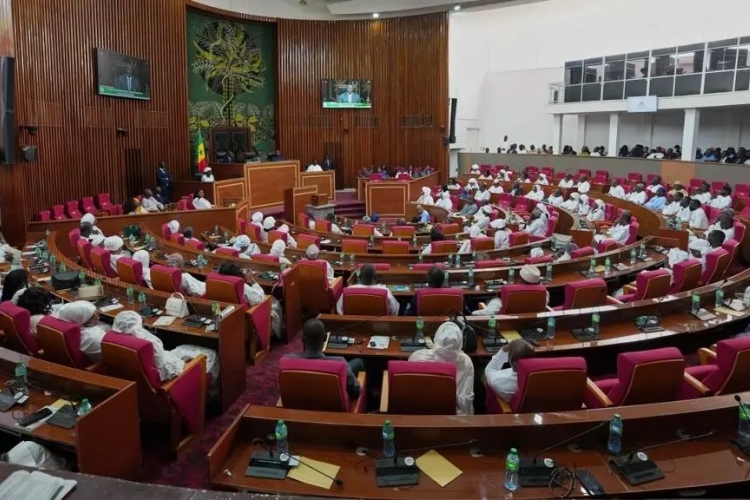
Gambiaj.com – (DAKAR, Senegal) – Senegal’s National Assembly is set to vote Monday on a controversial constitutional reform bill that has laid bare growing tensions between supporters of President Bassirou Diomaye Faye and the ruling Pastef party led by Ousmane Sonko.
The proposed amendments, introduced by Pastef lawmakers, are expected to pass comfortably given the party’s commanding majority of 130 seats in the 165-member parliament.
However, the legislation has triggered an unprecedented public dispute within Senegal’s ruling establishment, with President Faye’s coalition openly opposing key provisions of the bill.
The reform package is based on a draft initially prepared by the presidency and presented in April, with Pastef’s participation.
But President Faye’s supporters accuse the parliamentary group of substantially altering the original text through last-minute amendments that they say fundamentally change the balance of power within Senegal’s presidential system.
Among the most contentious provisions are measures that would restrict the president’s authority to dissolve the National Assembly to a single occasion during his term, require presidents to declare their assets both upon assuming office and at the end of their mandate, and clarify the legal framework governing charges of high treason against a sitting head of state.
Diomaye Coalition Demands Referendum
The dispute intensified over the weekend as both camps traded accusations through separate press conferences.
The coalition Diomaye Président, which backs President Faye, called for the immediate withdrawal of the bill, arguing that constitutional changes of such magnitude cannot be enacted solely through parliamentary approval.
Aminata Touré, the coalition’s general supervisor, maintained that the proposed amendments depart significantly from the original presidential draft and should instead be submitted directly to voters through a referendum.
According to Touré, President Faye intends to consult the Senegalese people on reforms that she argues would substantially alter the country’s presidential system.
She also accused Sonko of pursuing the amendments from a “revengeful” political position following his departure from the premiership and subsequent election as Speaker of the National Assembly.
The controversy has fueled speculation about a widening power struggle between President Faye and Sonko, whose alliance swept to power in 2024 but has increasingly shown signs of strain over questions of governance and institutional authority.
Opposition and Civil Society Raise Concerns
The Diomaye coalition’s objections have found support among opposition parties and sections of civil society, who have also criticized what they describe as a rushed process.
The opposition Senegalese Democratic Party (PDS) issued a statement insisting that the Constitution belongs exclusively to the Senegalese people and warning against major constitutional revisions undertaken without broad national consultation.
The party argued that reforms affecting the organization of state powers should not be driven by temporary political considerations and called for any substantial constitutional changes to be submitted to a referendum.
“The Constitution must remain above political power struggles,” the PDS said, describing a referendum as the most legitimate and democratic avenue for reforms of such significance.
Civil society movement Y’en a Marre also voiced strong opposition, accusing Pastef lawmakers of attempting to impose major constitutional changes without public consent.
The movement expressed concern over President Faye’s silence on the issue and urged him, as guarantor of the Constitution, to publicly clarify his position. It further warned against using a parliamentary majority to push through reforms that, in its view, should be decided directly by the Senegalese electorate.
Pastef Defends Reform Process
Pastef, however, has rejected accusations that the process lacks legitimacy.
Mohamed Ayib Daffé, president of the Pastef parliamentary group, argued that the reforms stem from recommendations emerging from the 2024 National Dialogue on Justice and the 2025 consultations on Senegal’s political system.
“We cannot remain in an endless dialogue in a country that wants to reform and move forward,” Daffé said. “At some point, after consultation and dialogue, institutions must assume their responsibilities. That is what Senegalese citizens expect from us.”
Despite the growing criticism, the bill appears likely to secure parliamentary approval unless there is a surprise rebellion within the ruling majority.
The vote is being closely watched as a test not only of Senegal’s constitutional future but also of the evolving relationship between President Faye and Pastef, whose overwhelming parliamentary dominance has increasingly become the focal point of debates over the distribution of power within the country’s new political order.




Leave a Reply