


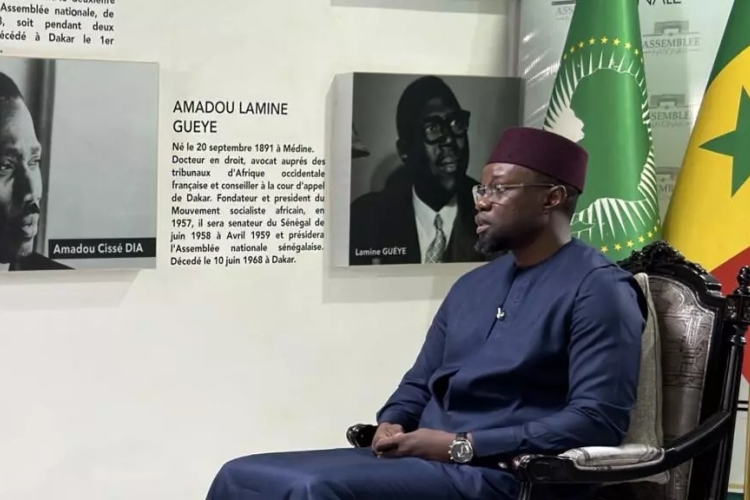
Gambiaj.com – (DAKAR, Senegal) – Three weeks after being dismissed as Senegal’s prime minister and subsequently elected Speaker of the National Assembly, Ousmane Sonko has defended his record in government, insisted that Senegal’s debt crisis must not be resolved at the expense of national sovereignty, and rejected personal responsibility for the death of a university student during a police operation he authorised.
In an interview with RFI and France 24, Sonko sought to downplay the significance of his removal from office by President Bassirou Diomaye Faye, describing it as part of Senegal’s political history rather than a defining moment in his career.
“I think this matter now belongs to Senegal’s political history,” Sonko said, adding that his focus is now on leading the National Assembly and ensuring the success of the mandate won by the ruling Pastef movement.
The former prime minister also dismissed suggestions that his dismissal was linked to preparations for a future presidential bid, saying his priority remains the country’s governance rather than personal political ambitions.
Debt Crisis Remains Central Concern
A significant portion of the interview focused on Senegal’s mounting debt burden, which Sonko described as one of the country’s most pressing challenges.
While acknowledging the seriousness of the situation, he maintained his longstanding opposition to what he called a “wild restructuring” of the debt, arguing that Senegal was still meeting its obligations while he was prime minister and therefore did not meet the conditions for such a measure.
“We were not in default. The country was respecting its commitments,” he said.
Sonko indicated that he would evaluate any future debt restructuring proposal on its merits but warned that he would oppose measures that sacrifice Senegal’s long-term economic transformation for short-term financial targets.
“If a solution is proposed that does not serve Senegal’s interests and sacrifices our options for systemic and structural change, we will not accept it,” he said.
He also revived the controversial debate over what he termed “odious debt,” arguing that part of Senegal’s debt stock was accumulated without proper parliamentary approval and therefore lacked democratic legitimacy.
According to Sonko, some of the liabilities inherited from previous administrations could qualify as odious debt under international legal principles because they were contracted without the consent of the Senegalese people and outside established legal procedures.
“A portion of this debt is indeed odious because it was not even approved by the National Assembly,” he said.
The former premier revealed that proposals to seek cancellation of some of these obligations had previously been discussed but were ultimately not adopted.
Defends Decision to Deploy Police at University
Sonko also faced questions about one of the most controversial episodes of his tenure: the February police intervention at the Cheikh Anta Diop University campus, during which a student was killed.
Critics have accused the government of using excessive force after Sonko authorised security forces to enter the university amid unrest.
The former prime minister defended the decision to deploy police, insisting that maintaining public order and protecting public facilities were legitimate government responsibilities.
“I will always take the necessary measures to preserve public order whenever my responsibilities require it,” he said.
However, Sonko acknowledged concerns about the conduct of some security personnel and said the available images suggested that excessive force may have been used during the operation.
“When unarmed young people are beaten publicly in the middle of security forces, that is disproportionate use of force,” he said. “When motorcycles are destroyed and smashed, that is disproportionate use of force.”
Despite those remarks, Sonko rejected suggestions that he should be held personally responsible for the student’s death.
He noted that an investigation was opened immediately after the incident and said its findings have already been submitted to prosecutors.
“You cannot say nobody has been held responsible. An investigation was launched and we do not yet know its conclusions,” he said.
Sonko argued that his instructions were limited to ensuring public order and protecting university facilities, including the rectorate and restaurants, from being set ablaze.
“The conduct of operations on the ground is not directed by the prime minister,” he said. “I do not go to the field telling individual officers what to do.”
Political Differences Persist
Although Sonko has publicly criticised President Faye for departing from key Pastef commitments, he avoided escalating tensions further during the interview.
He insisted that political disagreements between them would not tear the country apart and stressed that Senegal’s institutions must continue functioning regardless of personal differences.
“There can be political and programmatic divergences, but there will be no tearing apart of the country,” he said.
His comments come amid growing scrutiny of relations between the two men, whose alliance brought Pastef to power after a decade of opposition politics. While Sonko ruled out immediate moves against the president within the party, he indicated that Pastef’s leadership structures would ultimately determine whether any disciplinary measures become necessary.



Leave a Reply