


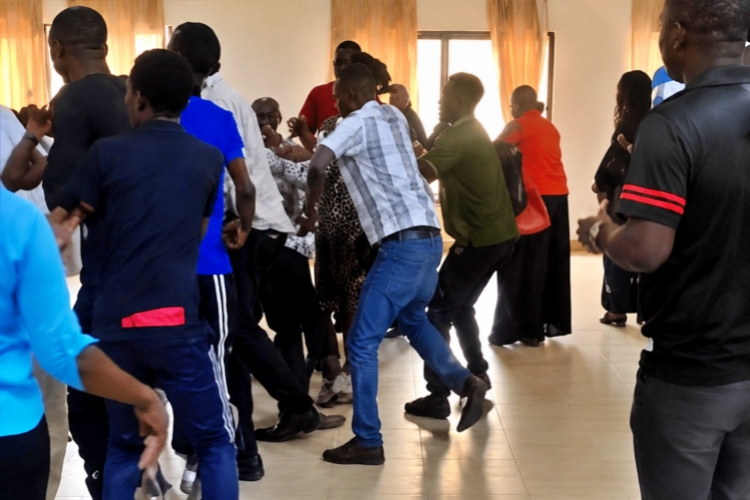
Gambiaj.com – (BANJUL, The Gambia) – Weeks after students at the University of The Gambia (UTG) successfully conducted elections widely seen as a significant test of youth participation in democratic processes, tensions and violence at a student congress on Wednesday in Kanifing have triggered deeper questions about the forces shaping campus politics and whether outside political actors may be influencing student affairs.
The fracas, which reportedly erupted during deliberations over the reading of the Students’ Union financial report, quickly descended into chaos, leaving at least one student injured and prompting intervention from the Police Intervention Unit (PIU).
At the center of the confrontation were rival student blocs, the Solutionist/Salvation Coalition and the Inter-School Alliance for Change, whose disagreement over congress procedure escalated into physical confrontation, according to student sources and eyewitnesses.
Police later questioned newly elected UTG Students’ Union president Ismaila Fadera in connection with the incident, though authorities confirmed that no arrests were made and that the engagement was aimed at calming tensions and preventing further escalation.
But beyond the immediate disorder, the incident has reignited longstanding concerns about the creeping influence of national partisan politics inside student movements, a phenomenon many Gambians associate with the authoritarian political culture of the Yahya Jammeh era.
From Democratic Promise to Violent Polarisation
The violence came at a particularly symbolic moment for the university community.
Only hours earlier, students had completed elections viewed by many observers as evidence of growing political maturity among Gambian youth.
The polls were seen as an important exercise in democratic participation, negotiation, campaigning, coalition-building and leadership transition, all essential ingredients of democratic culture.
For many students, the successful conduct of the elections had demonstrated that young people were capable of managing political competition peacefully within institutional frameworks.
The abrupt descent into confrontation during congressional proceedings, therefore, created a sharp contrast between democratic promise and political volatility.
A lecturer at the UTG says the incident reflects not merely personal rivalry among students but the increasingly factional nature of campus politics, where alliances often mirror broader political tensions in the country.
Growing Suspicion of External Political Interests
In the aftermath of the violence, speculation spread rapidly across student circles that external political actors may be quietly influencing student groupings at UTG.
The theory, widely discussed among students on social media and campus platforms, suggests that some student leaders enjoy backing from national political parties seeking to build influence among politically active youth.
No evidence has emerged to substantiate the claims, and no political party has been linked to the incident by authorities or university officials.
Nevertheless, the suspicions themselves reveal a deeper anxiety among students about the independence of campus politics.
Several student leaders at UTG are known to maintain close relationships with political actors outside the university, a reality that has become increasingly visible in recent years as youth activism gains prominence in national political discourse.
Political observers note that student unions in many African countries have historically served as recruitment grounds for future politicians, activists, and party organizers. In some cases, political parties cultivate influence within universities to shape narratives, mobilize support bases, or build future leadership pipelines.
In The Gambia, memories of political manipulation within student spaces remain particularly sensitive because of the country’s history under former president Yahya Jammeh, when student activism was often heavily monitored, infiltrated, or suppressed.
The latest tensions have therefore revived fears that partisan interests could again be filtering into student institutions, potentially undermining their autonomy and democratic culture.
A Reflection of National Political Climate?
The confrontation at UTG also mirrors a broader pattern of rising political polarization in the country’s public discourse.
Over the past few years, political debate in The Gambia has become increasingly confrontational, especially across social media platforms where rival political camps frequently engage in hostile exchanges. Observers warn that such behavior can easily trickle into youth and student spaces.
For some observers, the congressional violence may reflect how national political culture is being reproduced among younger generations.
Rather than serving as neutral civic institutions focused on student welfare and representation, student unions risk becoming extensions of external political battles if safeguards for institutional independence are weakened.
The concern is particularly significant because universities traditionally play a critical role in democratic development. Student unions are often regarded as training grounds where future leaders learn tolerance, debate, accountability, and peaceful political competition.
When those spaces become arenas for factional conflict or external manipulation, analysts warn, the broader democratic learning process may suffer.
Police Call for Calm
Police in Kanifing sought to downplay the severity of the incident, stressing that no arrests were made and urging students to accept the legitimacy of leaders elected through democratic votes.
Authorities said the intervention was intended to prevent escalation and restore calm following the disturbance.
Still, the incident has left many students concerned about whether the fragile democratic gains displayed during the elections can withstand growing political tensions within the university environment.
For now, the theories surrounding possible external influence remain speculative and unsupported by evidence.
But the speed with which such suspicions gained traction may itself be telling, reflecting a wider trust deficit and fear among students that campus politics is no longer insulated from the country’s increasingly competitive political landscape.
The events in Kanifing have therefore become more than an isolated student dispute. They have opened a broader conversation about the future of democratic culture among Gambian youth, the vulnerability of student institutions to political interference, and whether universities can remain independent civic spaces in an increasingly polarized environment.






Leave a Reply