


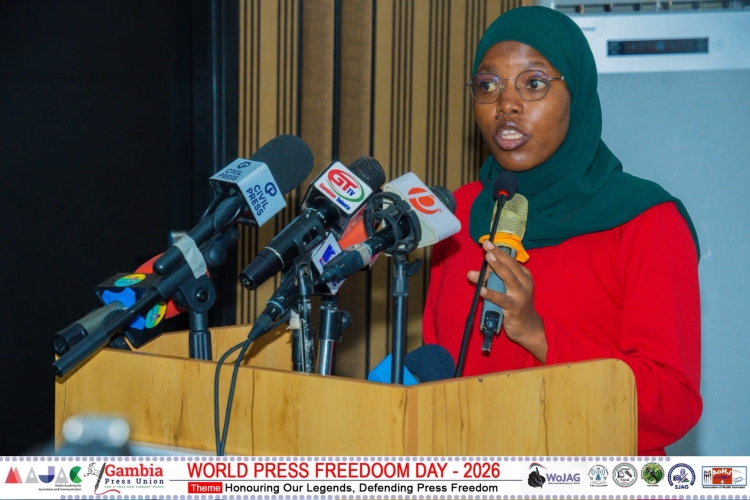
Gambiaj.com – (BANJUL, The Gambia) – Press freedom in The Gambia remains under pressure despite notable gains in recent years, Isatou Keita, President of the Gambia Press Union (GPU), has warned, pointing to weak political will, stalled reforms, and the emergence of restrictive legislation as key threats to the media landscape.
Speaking at the national commemoration of World Press Freedom Day 2026, Keita said concerns are mounting among journalists and stakeholders about the sustainability of the country’s democratic gains.
“These challenges include the absence of political will to protect journalists by adopting laws that safeguard the interests of the profession, incomplete media law reforms, and the creation of new restrictive laws that significantly put journalists under pressure and self-censorship,” she said.
The event, organised by the GPU in collaboration with the Media Academy for Journalism and Communication and its affiliates, brought together journalists, government officials, civil society actors, and development partners.
While acknowledging improvements in global press freedom rankings, Keita cautioned that progress remains fragile. She cited the latest index by Reporters Without Borders, which ranks The Gambia 46th out of 180 countries and 8th in Africa, but warned that these gains could easily be reversed if existing challenges persist.
A central concern, she noted, is the slow pace of media law reforms, many of which were recommended following the findings of the Truth, Reconciliation and Reparations Commission but remain unimplemented. According to Keita, some outdated laws continue to be used against journalists, further constraining their work.
She also raised alarm over newly proposed legislation, including the Cybercrime Bill 2023 and the Communications Bill 2025, which she said risk restricting freedom of expression, particularly in the digital space, and could discourage investigative journalism.
Recent incidents involving journalists, she added, underscore the growing pressure on the profession. Keita cited arrests of reporters covering protests in Banjul, allegations of police assault on media practitioners, and legal actions against journalists as troubling developments contributing to a climate of fear and self-censorship.
Beyond legal challenges, Keita highlighted economic pressures within the media sector, including the selective allocation of government advertising and limited financial support for private media institutions.
She further criticised the incomplete implementation of the Access to Information Act 2021, which she said continues to hinder journalists’ access to critical public information.
Keita called on the government to demonstrate stronger commitment by completing media law reforms and aligning national legislation with international standards. She also urged authorities to reconsider proposals for mandatory registration and licensing of journalists, warning that such measures could significantly restrict independent reporting.
Instead, she advocated for strengthening self-regulatory mechanisms, including the Media Council, and fostering greater collaboration among government, civil society, and media stakeholders.
World Press Freedom Day, she noted, should serve not only as a celebration of progress but also as a reminder of the ongoing responsibility to protect freedom of expression.
As the commemoration—held under the local theme “Honouring Our Legends, Defending Our Freedom”—concluded, participants renewed calls for collective action to safeguard press freedom and reinforce democratic accountability in The Gambia.








Leave a Reply