


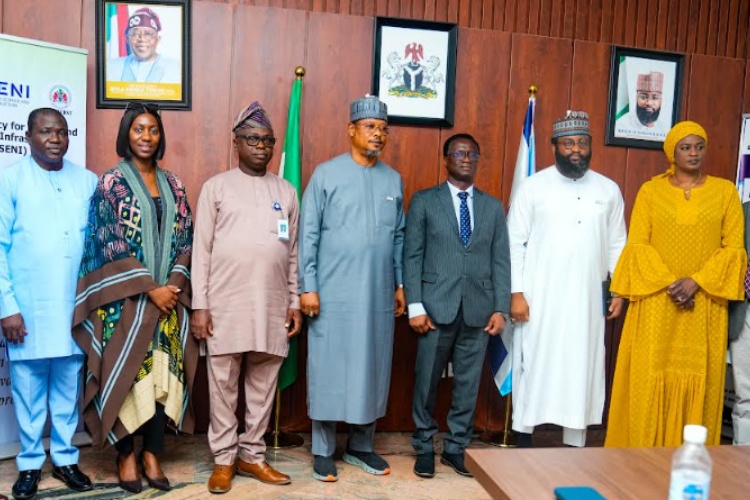
Gambiaj.com – (ABUJA, Nigeria) – The Gambia is moving to strengthen its cooperation with Nigeria in science, technology, and technical education following an agreement to develop a comprehensive Memorandum of Understanding (MoU) covering technology development, Technical and Vocational Education and Training (TVET), research, and commercialization.
The proposed partnership emerged from a visit by the minister of Higher Education, Research, Science and Technology Professor Pierre Gomez, to the headquarters of Nigeria’s National Agency for Science and Engineering Infrastructure (NASENI) in Abuja.
The visit exposed the Gambian delegation to Nigeria’s technology development ecosystem, including facilities involved in solar energy production, agricultural mechanization, advanced manufacturing, drone technology, and solid minerals processing.
Gambia Eyes Practical Skills
During the visit, Professor Gomez said The Gambia was looking to reshape its higher education and TVET system by placing greater emphasis on practical learning, institutional partnerships, and African cooperation.
He said the country needed to move away from an education model focused largely on certificates without sufficient practical knowledge.
“The Gambia is seeking to transform its higher education and TVET ecosystem through practical learning, institutional partnerships, and stronger African cooperation,” Gomez said.
He added that The Gambia was ready to pursue technology transfer as part of efforts to ensure that education produces young people with skills relevant to the economy and labor market.
The Gambian delegation toured NASENI Solar Energy Limited and the agency’s Centre of Excellence, where officials examined technologies and interventions in renewable energy, agricultural engineering, and advanced manufacturing.
From Research to the Marketplace
NASENI officials presented the agency’s approach to technology development through its “3Cs” strategy — Creation, Collaboration and Commercialization.
Director Engr. Ozigi O. Bernard said the model was designed to ensure that research and technological innovations do not remain confined to laboratories but are developed into products and services that can be deployed commercially.
According to NASENI, the agency has developed 44 commercially viable products, including solar-powered irrigation pumps and electric tricycles, while creating more than 30,000 jobs in 2025.
The agency operates through a network of specialized development institutes that provide platforms for research, prototyping, manufacturing, and technical training.
“NASENI was positioned to serve as a technology development, transfer, and commercialization platform for Nigeria and other African countries seeking to build indigenous technological capacity,” Bernard said.
For The Gambia, the Nigerian experience offers a potential model for linking universities and technical institutions more directly with industry, innovation, and employment.
Potential Areas of Cooperation
The proposed MoU is expected to cover areas including renewable energy systems, embedded systems, industrial automation, agricultural engineering, and technical skills development.
The cooperation could also provide opportunities for Gambian institutions and students to gain exposure to Nigerian research facilities, industrial technologies, and practical training programs.
The partnership comes as African countries grapple with the challenge of converting a rapidly growing youth population into an economic asset.
Africa’s youth population is projected to reach about 830 million by 2050, while employers across the continent continue to report shortages of workers with practical and industry-ready skills.
Against that backdrop, The Gambia’s interest in Nigeria’s technology ecosystem reflects a broader effort to make education more responsive to the demands of economic transformation.
A Continental Skills Challenge
The proposed Gambia-Nigeria cooperation also fits into the African Union’s broader push to strengthen TVET and skills development.
The AU’s Continental TVET Strategy 2025–2034 seeks to improve practical skills development as part of efforts to support industrialization, employment, and economic growth across the continent.
At Africa Skills Week 2025, African officials and stakeholders similarly stressed the importance of coordinated investment and stronger engagement with employers to address youth unemployment and skills mismatches.
For The Gambia, the significance of the proposed partnership lies particularly in its practical orientation.
With limited domestic industrial capacity and a need to expand opportunities for young people, cooperation with a larger African technology ecosystem could help Gambian institutions access expertise, technologies, and training models that would otherwise be difficult to develop independently.
The proposed Gambia-Nigeria MoU could therefore become part of that wider continental role for Nigeria while giving The Gambia a potential partner in its efforts to build indigenous technological and technical capacity.
For Banjul, the immediate challenge will be translating the proposed agreement into concrete programs, including training, technology transfer, joint research, industrial attachments, and commercial ventures, that can directly benefit Gambian students, institutions, and businesses.
If implemented effectively, the partnership could help shift the country’s skills agenda from qualification-driven education towards a system where young Gambians leave institutions not only with certificates but also with practical skills capable of supporting employment, entrepreneurship, and national development.

















Leave a Reply