


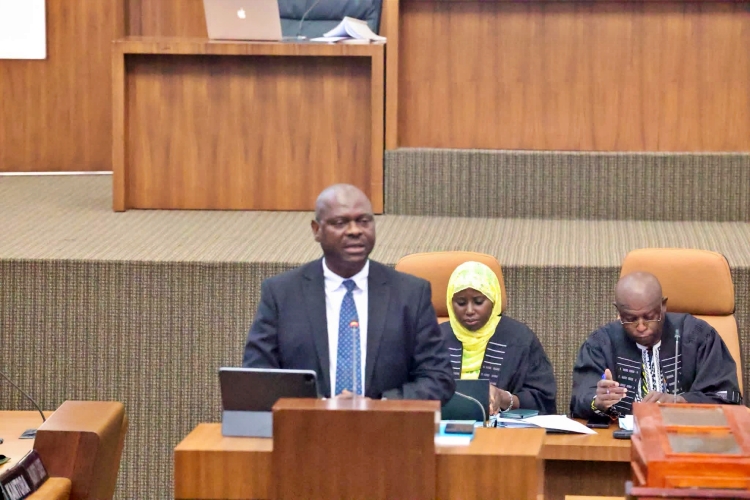
Gambiaj.com – (BANJUL, The Gambia) – Finance Minister Seedy Keita has warned that The Gambia cannot achieve its development ambitions while women continue to face barriers to full participation in the economy, describing gender inequality as not only a social concern but also a major economic and fiscal challenge.
Speaking on Tuesday at the launch of the World Bank’s Gambia Economic Update and Public Finance Review, Keita argued that the country is constraining its own growth by failing to fully harness the potential of half its workforce.
“The Gambia cannot achieve its development ambitions on half its potential,” the minister said.
He challenged the perception that gender equality is solely the responsibility of the Ministry of Gender, insisting that it must also be treated as a core economic and public finance issue.
“I am here because gender equality is a finance issue. It is a growth issue. It is a fiscal issue,” he said.
According to Keita, women’s labor force participation remains significantly lower than men’s, while women earn, on average, 26 percent less than their male counterparts. In rural areas, he noted, men earn approximately 50 percent more than women.
“This is not a gender statistics problem. This is a GDP problem. This is a tax base problem. This is a fiscal sustainability problem,” he said.
The minister said The Gambia stands to benefit substantially from reducing gender disparities in education, health, and economic participation. Citing international research, he noted that closing such gaps could increase GDP per capita by as much as 10 percent, while the long-term economic losses associated with women’s underutilized potential could amount to as much as 38 percent of GDP.
He also highlighted the economic costs of gender-based violence and child marriage, warning that both have serious implications for productivity, public spending, and long-term growth.
“These are not hypothetical projections. They are the compounded costs of policy inaction, costs that fall, ultimately, on the public budget,” he said.
Keita used the occasion to advocate for gender-responsive budgeting, arguing that public spending should be deliberately structured to ensure women benefit equitably from government investments.
“Gender-responsive budgeting is not about ring-fencing a percentage of the budget for women’s programmes,” he said. “It is about ensuring that every dalasi of public spending is designed and tracked to reach its intended beneficiaries and generates the returns the country needs.”
The minister further argued that greater participation by women in the formal economy would strengthen government revenues by broadening the tax base.
“A more gender-equal economy generates a broader tax base,” he said, noting that increased female participation in productive formal employment would boost income tax receipts, consumption taxes, and social security contributions.
World Bank Highlights Persistent Gender Gaps
Echoing the minister’s concerns, the World Bank’s Country Representative said gender inequality remains one of the most significant obstacles to The Gambia’s economic development.
“Being born a woman in The Gambia does not offer the same opportunities as being born a man,” the official said.
The World Bank noted that The Gambia ranks 172nd out of 190 countries on the United Nations Development Programme’s Gender Inequality Index.
While girls now outperform boys in primary and lower-secondary school enrollment, the Bank said those educational gains have yet to translate into equal economic opportunities.
“Women’s labor force participation remains significantly lower than men’s, earnings trail by an average of 26 percent, and most employed women are concentrated in informal, low-productivity work,” the official said.
The report identified child marriage, early pregnancy, unpaid care work, limited access to land and finance, and gender-based violence as key barriers that continue to restrict women’s economic participation.
Revenue Gains Amid Fiscal Pressures
The launch also provided an opportunity for the government and the World Bank to review the country’s fiscal performance.
Keita highlighted significant progress in domestic revenue mobilization, revealing that tax revenues have more than doubled over the past four years.
According to the Ministry of Finance, tax revenue increased from D11.39 billion in 2021 to D23.9 billion in 2025, raising the country’s tax-to-GDP ratio from 10.8 percent to nearly 13 percent.
The minister attributed the increase to a series of reforms, including tax administration improvements, digitalization initiatives, and efforts to curb revenue leakages.
Among the measures cited were the introduction of the ASYCUDA World customs system, digital excise tax stamps, fuel-marking technology, the Gambia National Single Window platform, and a digital rental tax compliance system.
Despite the gains, both the government and the World Bank acknowledged that significant fiscal challenges remain.
The World Bank noted that The Gambia’s tax-to-GDP ratio remains below the 15 percent benchmark widely regarded as necessary for financing growth-enhancing public investments.
“Low revenue remains a key structural constraint to Gambia’s development,” the Bank said, warning that limited domestic resources continue to constrain investment in infrastructure, social services, and job creation.
The institution also pointed to inefficiencies in public spending, particularly in the education, health, transport, and energy sectors, which continue to place pressure on public finances.
As The Gambia pursues reforms aimed at boosting revenue collection and improving expenditure efficiency, both the government and the World Bank stressed that women’s economic empowerment must be placed at the center of the country’s development agenda.
“Gender equality is not a cost to be managed,” Keita said. “It is a return to be realized.”














Leave a Reply