


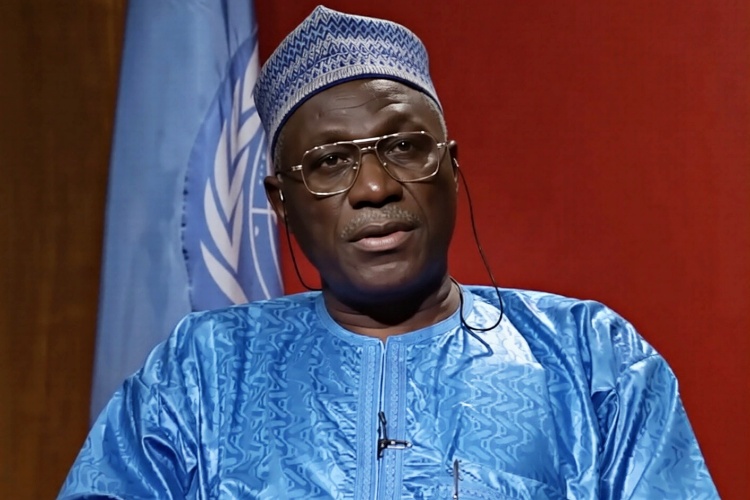
Gambiaj.com – (BANJUL, The Gambia) – In September 1999, I travelled to Windhoek, Namibia, as part of a Gambian delegation attending the 49th Session of the World Health Organization (WHO) Regional Committee for Africa. I remember that trip with particular pride. We had gone to support the re-election of Dr. Ebrahim Malick Samba, a Gambian who had already earned an exceptional reputation in African public health.
I was then Permanent Secretary at the Ministry of Health and Social Welfare, under the leadership of Her Excellency Isatou Njie-Saidy, Vice President and Minister of Health. With me were Cherno Jallow and Willy Joof from Foreign Affairs and Dr. Yankuba Kassama, then Director of Health Services. Our task was straightforward: to engage delegations from across the region and seek their support for Dr. Samba.
What stayed with me, however, was that we were not introducing an unknown Gambian candidate to the region. As we moved from delegation to delegation, many of the people we met already knew Dr. Samba and were familiar with his work.
His reputation had travelled ahead of us. We were seeking their support, but we were also witnessing the respect he had earned through years of service to African public health.
That experience gave the election a significance beyond the outcome itself. We were proud to support a Gambian, of course, but there was something even more gratifying in seeing that he was being judged on the strength of his own record.
When his re-election was confirmed, there was genuine excitement within the Gambian delegation. A Gambian had once again been entrusted with leading WHO’s work across the African region.
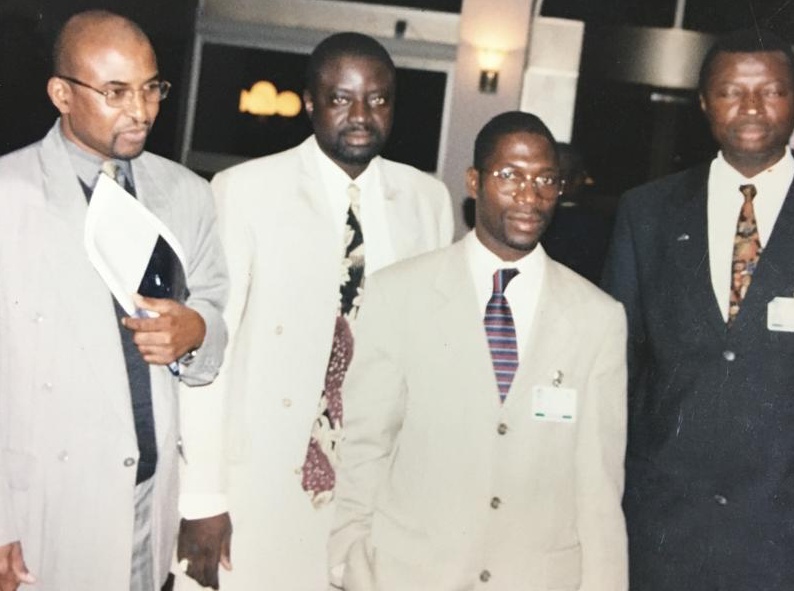
From Left to right: Cherno Jallow, Abdoulie Mam Njie, Willy Joof and Dr. Yankuba Kassama at the 49th Session of the World Health Organization (WHO) Regional Committee for Africa in Windhoek
A Record Built in Africa
That record had been built over many years. From 1980 to 1994, Dr. Samba led the WHO Onchocerciasis Control Program, one of the most ambitious public health initiatives undertaken in Africa at the time.
River blindness did not respect national borders, and controlling it required countries to work together over many years.
The program demonstrated what sustained regional cooperation, technical expertise, and determined leadership could achieve.
For The Gambia, however, his importance went beyond the distinction of having one of our own at the helm of WHO’s African region. Dr. Samba served as WHO Regional Director for Africa from 1995 to 2005, but his contribution to health was not confined to his international responsibilities.
He understood that a health system ultimately depends on the people who work within it. Hospitals, equipment, and infrastructure matter, but without trained professionals, they cannot deliver their full potential.
Building Medical Education at Home
During his tenure, WHO provided technical and institutional support for efforts to establish medical education in The Gambia. Through his office in Brazzaville, technical assistance and professional expertise were made available as the initiative developed.
He worked with Gambian and regional colleagues who shared the ambition of building medical education at home, among them Dr. Yankuba Kassama, Dr. Adama Sallah, Dr. Melvine George, Dr. Esanbedo, and Professor Kaba Joiner, then Director-General of the West African Health Organisation.
For The Gambia, the establishment of medical education was a major step. We had long depended on sending students abroad for medical training. A medical school at home meant that Gambians could increasingly be trained within their own system and that the country could develop doctors familiar with its own health needs.
It marked an important shift from relying heavily on expertise produced elsewhere towards developing that capacity ourselves.
The progress since then has been considerable. In July 2025, the Islamic Development Bank approved US$32.2 million in financing for a modern School of Medicine and Allied Health Sciences at the University of The Gambia’s Faraba Banta campus.
For those who witnessed the early development of medical education, the investment is particularly gratifying. It shows how an initiative that once required considerable international support has grown into a significant national institution.
But training doctors was only the beginning.
The Next Step: Specialist Training
For many years, a Gambian doctor who wanted to specialize generally had to leave the country. Some returned, while others established careers elsewhere. This made it difficult to build the pool of specialists needed by a growing health system.
Postgraduate medical training was therefore a natural next step.
With World Bank support, specialist training programmes were developed to enable Gambian doctors to undertake postgraduate training without having to leave the country for every stage of their professional development. World Bank-supported work included the recruitment of international specialist trainers and consultants, with programs covering areas including surgery, obstetrics and gynaecology, and oral and maxillofacial surgery.
Several people helped move this work forward. Samuel Lantei Mills provided valuable support from the World Bank side, while Dr. Yankuba Kassama played an important coordinating role. Dr. Mustapha Bittaye, then Director of Health Services, strongly supported the establishment of the programs, as did Dr. Adama Sallah, then Chair of the Board of the Edward Francis Small Teaching Hospital.
Dr. Melvine George and Dr. Esanbedo also advocated for strengthening dental training in response to the shortage of dental specialists.
Accreditation was an important part of those early efforts, and I had the opportunity to witness some of the first cohorts of Gambian doctors begin and progress through specialist training. Dental training has likewise continued to develop as The Gambia works to build its own dental workforce.
By the grace of God, Dr. Mustapha Bittaye is now heading the Edward Francis Small Teaching Hospital. He is himself a product of the medical education system established in The Gambia, having gone through the medical school here before later becoming Director of Health Services and supporting the development of postgraduate medical training.
His journey is a particularly fitting example of how the institutions established by one generation can produce the professionals who strengthen them in the next.
The Challenge of Keeping Our Own
That brings us to the next, and perhaps more difficult, challenge: retaining the people we train.
If we are prepared to spend substantial public resources training doctors and specialists, we must also create conditions that encourage them to remain in The Gambia.
Training a doctor is expensive; losing that doctor after years of public investment is even more costly.
Salary is part of the equation, but it is not the whole equation.
Doctors and specialists need functioning hospitals, appropriate equipment, opportunities for further training, professional recognition, fair promotion, and good working conditions. They need opportunities to teach, conduct research, mentor younger colleagues, and develop professionally.
They need to see a future in which remaining in The Gambia does not mean sacrificing professional advancement.
This is particularly important as our investment in medical education increases. Development partners can help finance buildings, equipment, and training programs, as they have done over many years. But the long-term responsibility for maintaining and retaining the health workforce rests with the Gambian state.
Medical education and retention must therefore be treated as two parts of the same investment.
It makes little sense to celebrate the number of doctors and specialists we train if too many eventually leave because the professional environment at home cannot support them.
The objective should not simply be to produce more graduates. It should be to build a health system in which those graduates can practice, specialize, teach, conduct research, and contribute to the development of the next generation.
A Legacy Worth Building On
Dr. Samba is one of those Gambians whose international contribution deserves to be better remembered at home. His career demonstrated what a Gambian could achieve at the highest levels of African and international public health, while his contribution to medical education showed how international experience could also help strengthen institutions at home.
My recollection of Windhoek in 1999 is therefore more than a memory of an international meeting. It was a reminder of the respect a Gambian could command through competence, experience, and a record of service.
It was also a reminder that achievement matters most when it creates opportunities for those who come after.
Today, medical education has grown, postgraduate training has become a reality, dental training continues to develop, and further investment is expanding the country’s capacity to train health professionals.
The task now is to ensure that these investments translate into a strong, sustainable health workforce for The Gambia.
The best way to honor Dr. Samba’s legacy is to build on what he helped start: strengthen our health institutions, develop our people, and give them a reason to stay and serve.











Leave a Reply