


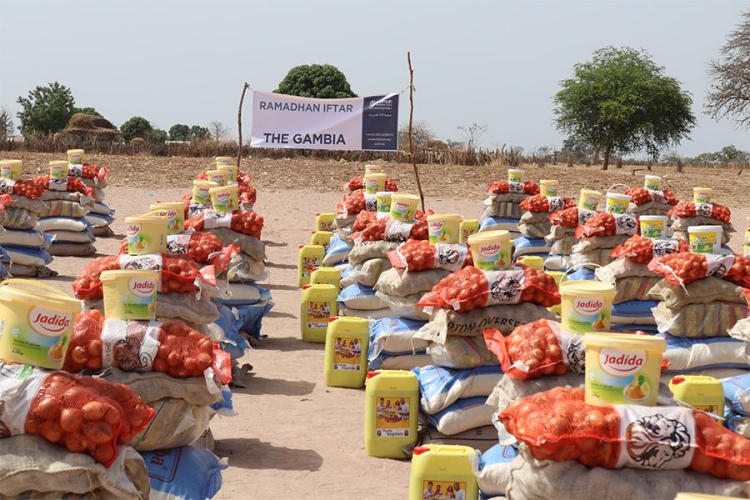
Gambiaj.com – (BANJUL, The Gambia) – A few weeks ago, I came across a short video about a man remembered across history as Hatim al-Tai, a name that has become synonymous with generosity. The story was simple, yet it lingered long after the screen went dark. This reflection grew out of that quiet persistence.
There was a time when a person’s worth was measured not by what they accumulated, but by what they were willing to give. In that time lived Hatim, whose generosity was so profound that it outlived him, becoming a standard by which others are still judged.
Even today, when generosity reaches uncommon heights, people say, “He is like Hatim.”
In The Gambia, we may not always invoke his name, but we have long understood his spirit.
It lived in our compounds, where meals were shared without counting plates.
It lived in traditions of hospitality, where a stranger could arrive unannounced and still be received with dignity. It lived in the quiet understanding that no one should go to bed hungry if others had something to give.
These were not acts of charity. They were expressions of identity.
Yet across our towns and villages, a subtle shift is taking place.
Generosity has not disappeared, but it has become more cautious, more measured, and at times more selective. The pressures of modern life are real, and they are reshaping how we respond to one another. Individual success is increasingly celebrated, sometimes at the expense of collective responsibility.
This is not a condemnation. It is a recognition.
The question is whether, in this transition, we are losing something essential.
Hatim did not give because it was easy. He gave because he believed that what he possessed was never his alone. His generosity was not drawn from abundance but from conviction. It rested on a simple truth: dignity is shared, and responsibility to others is not optional.
That truth is not foreign to us.
As Gambians, we have long understood that community comes before self. We know hardship is rarely borne alone and that resilience is strongest when it is shared. These values are not abstract; they form the foundation of our social fabric.
But foundations, when neglected, begin to weaken.
Today, families feel the strain of rising costs. Young people face uncertainty with fewer assurances. Communities that were once tightly bound are beginning to fray. In public life, competition is often more visible than compassion.
And yet, generosity endures.
It lives in the market woman who extends credit without certainty of repayment. It lives in the neighbor who quietly supports a struggling family. It lives in the civil servant who chooses integrity over personal gain. It lives in countless acts of kindness that pass unnoticed, but never without consequence.
These are not grand gestures. They are quiet continuities.
The challenge before us is not to romanticize the past but to renew its values in the present.
Generosity is not defined by how much we have. It is defined by how we see one another. It is reflected in whether we recognize that our well-being is interconnected and whether we are willing to act on that truth, even when it demands sacrifice.
If generosity becomes rare, we risk more than individual hardship. We risk weakening the bonds that hold us together. Trust begins to erode. Solidarity fades. And the quiet strength that has sustained this country through difficult times becomes harder to find.
Hatim is remembered not because he was wealthy, but because he understood something fundamental: giving does not diminish a person; it defines them.
We do not need to become Hatim. But we must not become a people who forget what he represents.
In the end, the measure of The Gambia will not rest only on its progress or its achievements. It will rest on whether we continue to care for one another and whether, in our own quiet ways, we keep alive the spirit that once made generosity not an exception but a way of life.
Because when that spirit fades, we will not need to ask what we have lost.
We will feel it.













Leave a Reply