


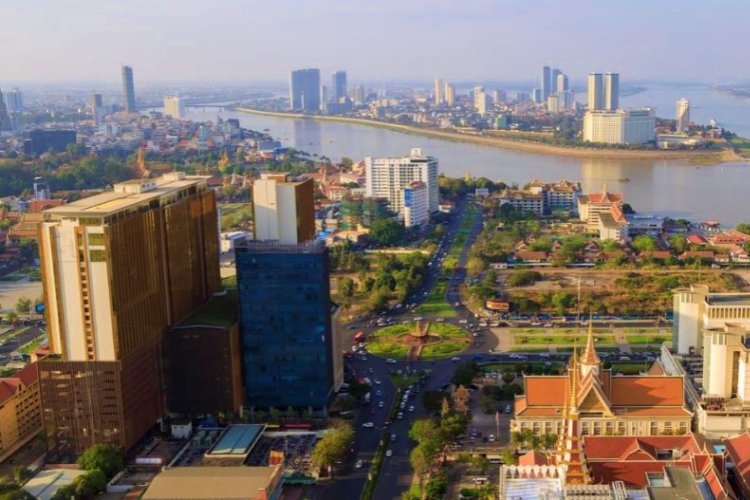
Gambiaj.com – (PHNOM PENH, Cambodia) – The Cambodian government has ordered all African nationals to leave the country by May 31, 2026, warning that anyone found on its soil from June 1 will face arrest, a two-year prison sentence, and a financial penalty of $8,000, roughly equivalent to one million Kenyan shillings, before being deported.
The directive, issued by Cambodia’s General Department of Immigration, marks the expiry of a waiver previously extended to African nationals and signals a sharp enforcement posture from Phnom Penh as it moves to clamp down on what it describes as immigration violations.
“Any foreign national who enters, remains, or is found in Cambodia from June 1, 2026 will be arrested at the airport or at any location,” the official notice states.
The order covers citizens of Kenya, Ghana, Cameroon, Uganda, and other African countries and applies to all affected foreigners whose immigration fines have been cleared but who have yet to depart.
Cambodian police have also been directed to begin active operations against foreigners found hiding within the country’s borders. “The Cambodia Police will start arresting any foreigner at any hideout in Cambodia from the 1st of June 2026 for overstaying and will hand over to the immigration authorities for legal action,” the notice further reads. “The Royal Government of Cambodia will not tolerate any violation of our immigration laws.”
The Human Cost Behind the Numbers
While the directive is framed in the language of immigration enforcement, it has cast a harsh spotlight on a far more troubling reality, one that human rights advocates and migration experts say the Cambodian government’s language dangerously obscures.
Many of the African nationals stranded in Cambodia, according to rights groups and survivor testimonies, are not illegal migrants in the conventional sense.
They are, in significant numbers, victims of human trafficking, men and women who traveled to Southeast Asia on the promise of legitimate, well-paying jobs, only to find themselves ensnared in criminal enterprises they never knowingly joined.
The trafficking pipeline has been well-documented. Recruitment typically begins online, with advertisements on social media platforms and messaging applications offering positions in customer care, casino operations, cryptocurrency trading, and technology firms. The salaries advertised are often several times what the same workers could earn at home.
Once in the region, however, a nightmarish reality frequently awaits. Survivors have described being transferred between brokers, having their passports confiscated, and being held in heavily guarded compounds.
Those who resist or attempt to flee are reported to face physical abuse and debt bondage, with employers inventing “fees” for accommodation, food, and transport, and threats against their families. Leaving, many have discovered, requires paying large “release fees” that most cannot afford.
A number of Kenyan nationals stranded in Cambodia, Myanmar, and Laos have in recent years made desperate public appeals for their government’s intervention, citing abuse, intimidation, and an inability to raise funds either for travel home or to clear immigration penalties imposed on them through no fault of their own.
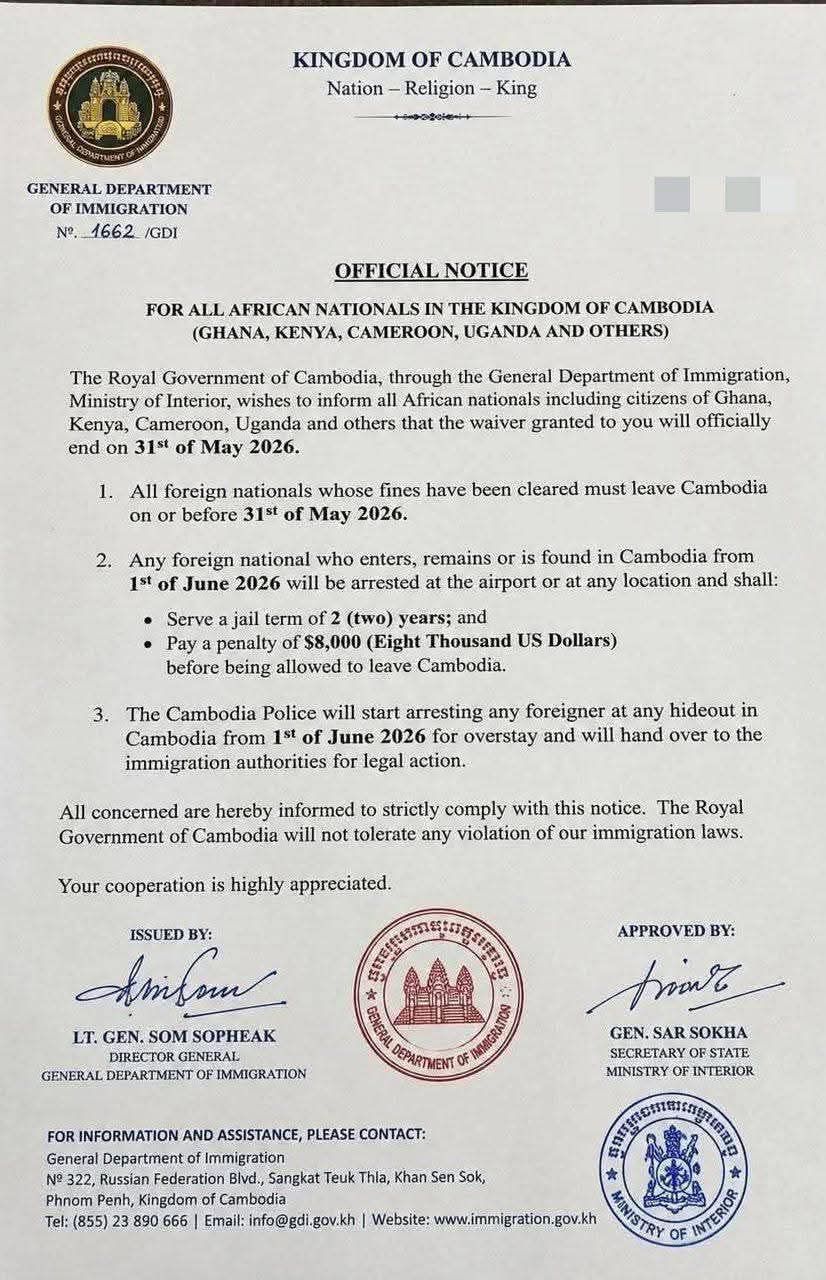
The official notice issued by Cambodia’s General Department of Immigration under the Ministry of Interior
A Region Under Scrutiny
Cambodia’s notice arrives against a backdrop of sustained international alarm over the proliferation of transnational cybercrime and human trafficking operations across Southeast Asia. International watchdogs and human rights organizations have, in recent years, identified Cambodia, alongside Myanmar and Laos, as major hubs for large-scale online fraud networks.
These operations, typically run by organized criminal groups with reported links to powerful regional actors, have targeted victims globally, using trafficked foreign workers as the human engine of schemes involving romance scams, cryptocurrency fraud, and other forms of online deception.
The United Nations and several international NGOs have documented thousands of cases involving victims from Africa, South Asia, and beyond.
The irony, and the tragedy, that campaigners now highlight is stark: many of those being threatened with arrest and prosecution under Cambodia’s immigration laws are themselves the victims of the very criminal networks that international law enforcement has been struggling to dismantle.
What This Means for West Africans
While the Cambodian directive has so far generated the most attention in East African media given the documented cases involving Kenyan nationals, the order covers all African citizens without distinction. For West Africans, including citizens of Ghana, Cameroon, and potentially others, the implications are equally serious.
Migration and trafficking experts warn that the promise of jobs in Asia, amplified through social media channels and often brokered through informal networks, has increasingly drawn young West Africans into routes that expose them to exploitation.
Human rights organizations have urged African governments to take the May 31 deadline seriously and to immediately begin reaching out to their nationals in Cambodia, particularly those who may be stranded against their will, to facilitate emergency consular support and repatriation assistance.
A Deadline, Not a Solution
As the May 31 deadline draws near, the Cambodian directive raises uncomfortable questions that a date on a notice cannot answer. For the trafficking victim whose passport was taken the day they arrived and who has spent months or years trapped in a compound, a government order to simply leave the country by month’s end is not a solution; it is an added threat layered onto an already devastating situation.
Rights advocates are calling on both Cambodia and African governments to distinguish clearly between willing immigration violators and trafficking victims and to ensure that enforcement actions do not further punish those who are already among the most vulnerable.
What began as a migration enforcement notice has, in effect, renewed urgent calls for a coordinated regional and international response to one of Southeast Asia’s most persistent and brutal human rights crises.










Leave a Reply