


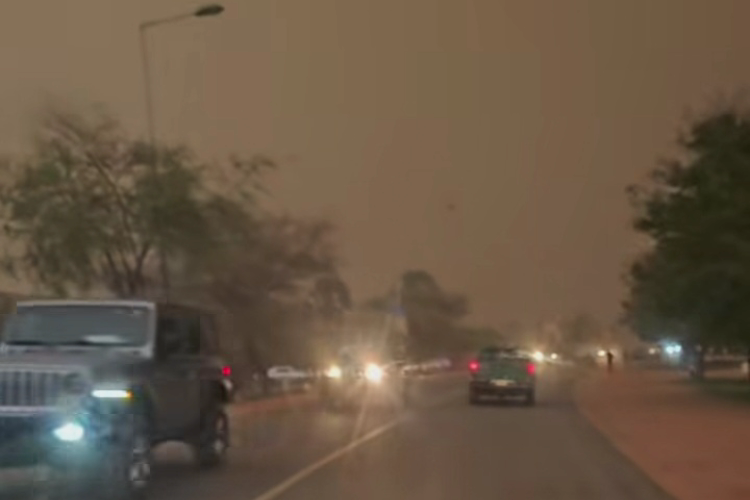
Gambiaj.com – (BANJUL, The Gambia) – Yesterday, Tuesday, 14 July 2026, at approximately 2:30 p.m., the sky over much of The Gambia darkened with remarkable speed.
For a brief moment, daily routines came to a halt as strong winds gathered and heavy clouds transformed the afternoon into what felt like evening. Conversations shifted from ordinary concerns to a single question: What is happening?
Meteorologists will explain the science behind such events. They will speak of atmospheric pressure, moisture, seasonal weather systems and storm formation. Their explanations are essential because they help us understand how nature works.
Yet science and reflection answer different questions. Science explains how. Reflection asks what such moments should awaken within us.
As I watched today’s sky, my thoughts travelled far beyond The Gambia. I remembered the Indian Ocean tsunami of 2004, the COVID-19 pandemic, devastating floods across continents, prolonged droughts, record-breaking heatwaves and destructive wildfires. Each event has a scientific explanation. Yet each also serves as a reminder of humanity’s fragility.
The Qur’an repeatedly invites human beings to reflect on the signs of creation. “Indeed, in the creation of the heavens and the earth and the alternation of the night and the day are signs for people of understanding” (Surah Aal ‘Imran 3:190–191). It also reminds us, “We will surely test you with something of fear, hunger, loss of wealth, lives and fruits…” (Surah Al-Baqarah 2:155). Another verse declares, “Corruption has appeared on land and sea because of what people’s hands have earned…” (Surah Ar-Rum 30:41), encouraging humanity to return to righteousness and responsibility.
These verses do not permit us to declare with certainty that every disaster is a punishment from God. Such knowledge belongs to Him alone. Rather, they call us to humility, repentance, gratitude and sincere reflection.
History offers similar lessons. During the plague in the time of Caliph Umar ibn Al-Khattab, practical measures were combined with trust in Allah. Great civilizations have endured earthquakes, famines and epidemics. Every generation eventually discovers that power, wealth and technology cannot remove every danger.
Our own generation has reached extraordinary scientific heights. We have artificial intelligence, satellites, remarkable medical advances and instant communication.
Yet a microscopic virus brought the world to a standstill. A massive wave wiped out entire communities. Extreme heat has tested nations with vast resources. Nature continues to remind us that human achievement does not eliminate human dependence.
Yesterday’s storm also revealed something beautiful. People checked on their neighbours, slowed their journeys and gathered with their families. For a few moments, we were reminded of what truly matters.
Perhaps that is the real lesson. Nature explains itself through scientific laws, but it also invites us to examine ourselves. Are we becoming more compassionate? Are we protecting the earth entrusted to us? Are we grateful for the blessings we so often overlook until they are interrupted?
The sun returned over The Gambia, as it always does after a storm. But perhaps the better question is not whether nature is speaking. The better question is whether we are listening.
If yesterday’s darkened sky leaves us with greater humility, deeper gratitude, renewed compassion and a stronger awareness of our dependence on God, then it will have illuminated far more than it ever concealed.










Leave a Reply