


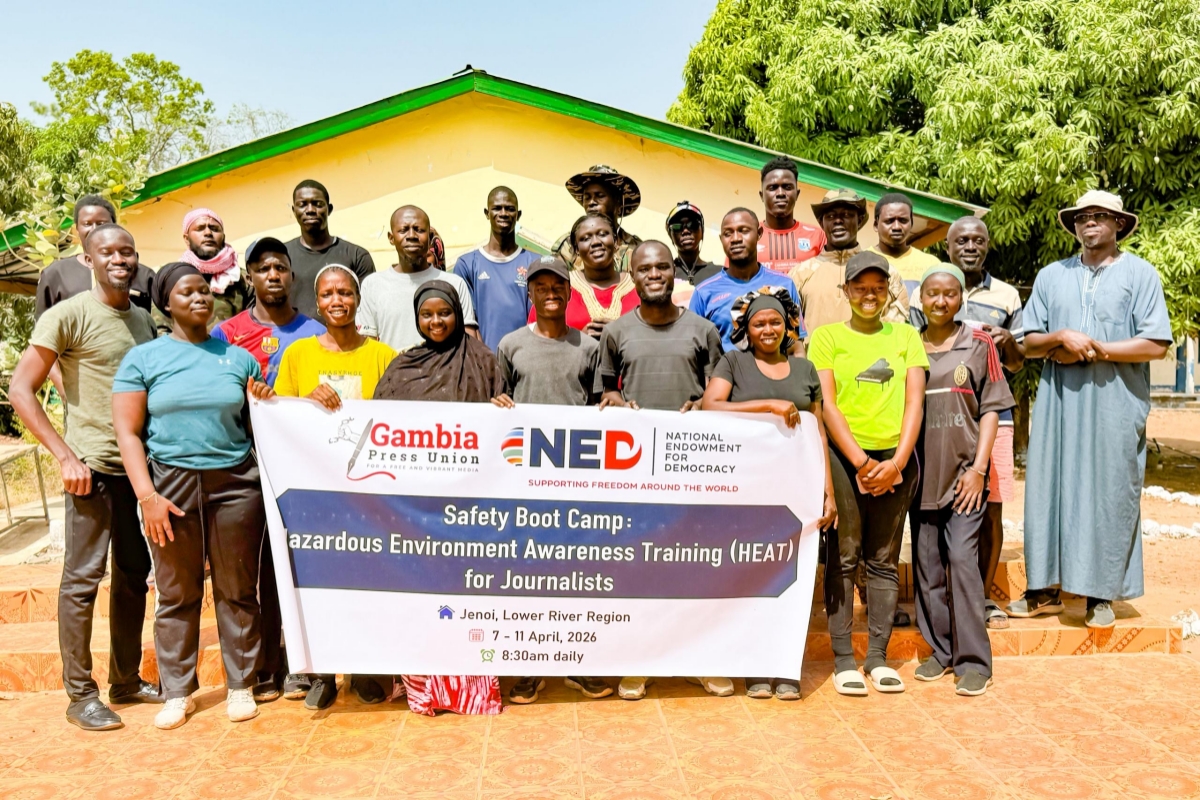
Gambiaj.com – (BANJUL, The Gambia) – Twenty-one journalists on Saturday wrapped up a four-day hazardous environment awareness and safety training, emerging with a renewed focus on survival as reporting conditions grow increasingly volatile ahead of The Gambia’s 2026 and 2027 elections.
The training, organized by the Gambia Press Union (GPU) with support from the National Endowment for Democracy (NED) and partners, forms part of ongoing efforts to strengthen journalists’ preparedness for high-risk assignments, including protests, political unrest, and online threats.
Participants engaged in rigorous simulations and real-life scenario exercises designed to sharpen their responses to danger, improve stress management, and enhance rapid decision-making in the field.
Speaking at the closing session, GPU Secretary General Modou Joof cautioned that the approaching election cycle is likely to be tense.
“This year, and the ones ahead, will not be easy. There will be tension, there will be protests, and some may turn violent. But no story is worth your life,” he warned.
The latest cohort brings the total number of journalists trained since 2025 to 104, following earlier safety and digital security sessions, including specialized programs for women journalists. Despite this progress, the figure represents only a small portion of the more than 1,000 media practitioners operating across the country.
Organisers say the programme is being expanded to ensure more journalists acquire practical tools to report responsibly while navigating increasingly hostile environments.
For participants, the training marked a shift from traditional notions of journalistic bravery to a more calculated and safety-conscious approach.
Arret Jatta of The Standard described the experience as transformative.
“We learned how to stay alive. It’s not just about getting the story anymore, but knowing when to step back, when to leave, and how to protect yourself and your colleagues,” she said.
Jatta highlighted emotional control as one of the most critical lessons, noting that instinct-driven reactions in tense situations can heighten risk.
“You learn to think first. That alone can save your life,” she added.
Similarly, Alieu Ceesay of Alkamba Times said the training reshaped his understanding of professional courage.
“We have always believed bravery means pushing forward no matter what, but being smart is just as important,” he said.
He emphasized the importance of de-escalation, particularly in encounters with security forces.
“If they tell you to leave, you leave and report it later. That’s how you stay in the profession,” he noted.
Beyond individual safety, the training stressed collective responsibility, urging journalists to look out for one another during field assignments, especially in protest situations.
Joof noted that some past incidents could have been avoided if journalists had prioritised teamwork and mutual protection.
He also raised concerns over delays in reporting press freedom violations, with many cases first surfacing on social media rather than through formal channels.
To address this, new mechanisms supported by the International Freedom of Expression Exchange (IFEX) have been introduced. These include the appointment of a dedicated safety monitor, Daniel Ceesay, tasked with tracking and responding to incidents in real time. A hotline and legal support system are also expected to be rolled out.
As the training concluded, organizers underscored the need for journalists to translate these lessons into everyday newsroom practices and field reporting.
“We cannot keep these lessons to ourselves. If one journalist is safer, we all become safer,” Jatta said.
For Ceesay, the takeaway was clear:
“At the end of the day, the goal is to go out, do your job, and come back alive.”








Leave a Reply