


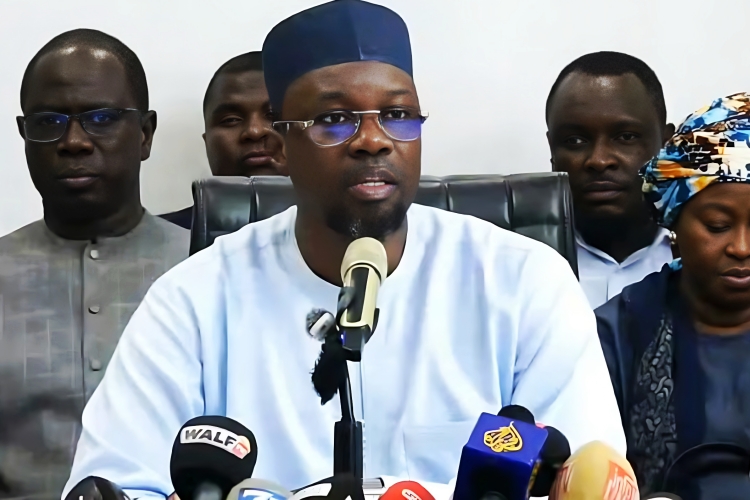
Gambiaj.com – (DAKAR, Senegal) – Ousmane Sonko, president of the PASTEF – Les Patriotes, has disclosed details of his dismissal as Senegal’s prime minister, insisting that President Bassirou Diomaye Faye alone decided to end their political partnership and that he cannot be held responsible for the split.
Speaking during a press conference on Tuesday, Sonko said there had been no prior discussions or mutual agreement regarding his departure from government before he was informed by the president that their collaboration could no longer continue.
According to Sonko, President Faye summoned him to the presidential palace on the afternoon of May 22, shortly before his dismissal. He said he attended the meeting after performing prayers at a mosque.
“The president told me that he believes our partnership can no longer continue,” Sonko said, adding that Faye cited several of his public statements, particularly remarks made at the National Assembly, as reasons for the decision.
Sonko stressed that President Faye had never shown him disrespect during their working relationship but said he rejected a proposal to present his departure as a jointly agreed decision.
“I could not assume responsibility for this separation,” he told reporters.
Sonko Says He Encouraged President to Proceed With Dismissal
The PASTEF leader said he did not attempt to resist the president’s decision.
“I told him that if he wanted to dismiss me, he should simply assume responsibility and do it,” Sonko said.
He also revealed that, at an earlier stage, he had proposed stepping down from government to become Speaker of the National Assembly while continuing to support President Faye’s administration, though the proposal was never implemented.
Dispute Over Formation of New Government
Sonko further claimed that he learned of the appointment of a new prime minister without being consulted by the president.
Following the announcement, he convened a meeting with outgoing PASTEF ministers. However, he said the same ministers later informed him that they had been summoned separately by President Faye.
Sonko said he advised them not to attend, arguing that the president could not bypass party structures and directly engage party officials after his dismissal.
“The president cannot jump over the party and its structures to call its cadres and weaken PASTEF,” he said.
According to Sonko, PASTEF subsequently held consultations and concluded that the party could not participate in the new government unless discussions were conducted through its leadership.
He said the president later attempted to contact party officials again, but they maintained that any decision regarding ministerial participation had to be made by PASTEF.
Failed Attempts at Reconciliation
Sonko said he personally contacted President Faye in an effort to preserve political stability and proposed a delegation comprising senior party figures, including Birame Souleye Diop, Aliou Sall, Daouda Ngom, and El Malick Ndiaye, to discuss the situation with the president.
He claimed President Faye initially refused to meet the delegation, arguing that some of the proposed representatives did not respect him. After further discussions, however, the president agreed that they could meet the newly appointed Prime Minister.
Sonko said he was subsequently promised a direct follow-up conversation with President Faye, but that call never came.
He later attended another meeting at the presidential palace, where he argued that, given PASTEF’s parliamentary majority, the party should retain a leading role in forming the government and that the prime minister should come from within PASTEF.
Objections to Reduced PASTEF Representation
A major point of disagreement, Sonko said, concerned the composition of the new cabinet.
While praising the performance of PASTEF ministers in the previous administration, Sonko said he opposed a proposal that would have reduced the party’s ministerial representation from 21 portfolios to seven.
He also objected to President Faye’s position that key sovereign ministries should be entrusted to politically neutral figures.
“I concluded that PASTEF could not participate in the new government,” Sonko said.
The former prime minister also disputed accusations that PASTEF ministers had shown divided loyalties.
According to Sonko, President Faye argued that ministers could not serve in government while publicly affirming loyalty to him as party leader. Sonko said he challenged that characterization during their discussions.
“A Government Without Political Support”
Sonko was particularly critical of the new administration, describing it as a technocratic government lacking a political foundation.
“This is a government without any political base, which is why they call it a government of technocrats,” he said.
He argued that every Senegalese government since independence had been built on political parties, citing administrations led by Léopold Sédar Senghor, Abdou Diouf, Abdoulaye Wade, and Macky Sall.
Sonko maintained that PASTEF had made significant sacrifices to support President Faye’s rise to power and accused the president of choosing to govern without the party’s political backing or parliamentary majority.
The remarks mark Sonko’s most detailed public account yet of the breakdown in relations between the two leaders, whose alliance delivered a historic electoral victory in Senegal in 2024 but has now culminated in an unprecedented split between the presidency and the ruling party that brought it to power.






Leave a Reply