


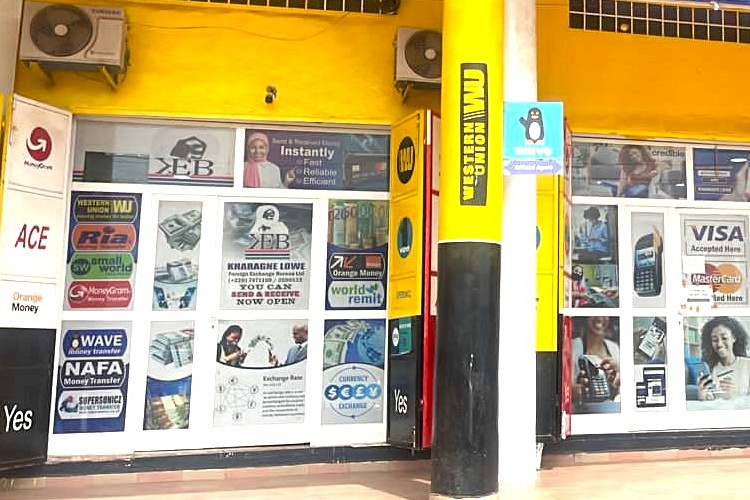
Gambiaj.com – (BANJUL, The Gambia) – The Gambia has emerged as the African economy most reliant on remittances, with money sent home by migrants equivalent to 22 per cent of the country’s gross domestic product in 2025, according to a new report by the International Fund for Agricultural Development (IFAD).
The Sending Money Home 2026 report estimates that The Gambia received about US$529 million in remittances in 2025, equivalent to 160 percent of the country’s exports. Remittance inflows to the country increased by 263 per cent between 2016 and 2025, according to the report.
The figures place remittances at the center of The Gambia’s economy, particularly for households that depend on relatives abroad to meet everyday needs and cope with economic pressures.
The Gambia Ahead of Regional Neighbors
The Gambia’s dependence on remittances is considerably higher than that of neighboring Senegal, where remittances were estimated at US$3.27 billion in 2025, equivalent to 11 percent of GDP and 27 percent of exports.
Senegal’s remittance inflows grew by 65 per cent between 2016 and 2025, while the estimated cost of sending money to Senegal through non-bank services was 2.3 per cent in 2025.
The contrast highlights an important distinction between the size of remittance flows and their importance to an economy.
Senegal receives far more money in absolute terms, but remittances represent a much smaller share of its national economy than they do in The Gambia.
The Gambia is also more dependent on remittances than several other West African economies. Cabo Verde’s remittances represented 12 percent of GDP, Guinea-Bissau’s 10 percent, Liberia’s 21 percent, and Nigeria’s 16 percent in 2025.
Nigeria remains by far the largest recipient in West Africa in absolute terms, receiving an estimated US$22.8 billion in 2025. Ghana received US$2.42 billion, Côte d’Ivoire US$1.77 billion, and Liberia US$1.02 billion.
Remittances Are A Lifeline For Gambian Families
The IFAD report says remittances are used by families for food, healthcare, education, housing, utilities and other everyday expenses. They can also help households manage unemployment, poor harvests, economic shocks, and unexpected costs.
This makes the Gambian figure significant beyond its contribution to national income.
With remittances equivalent to more than one-fifth of GDP, disruptions affecting Gambians abroad, international employment conditions, exchange rates, or money-transfer systems could have consequences for households and the wider economy.
IFAD cautions that smaller economies that are highly dependent on remittances can be particularly exposed to changes in migrant employment, exchange rates, and transfer channels. Even relatively modest disruptions can affect household consumption, foreign-exchange availability, and national income.
The report also estimates that 34 percent of Africa’s remittance inflows, or about US$42 billion, reached rural areas in 2025. Such transfers are particularly important for households with limited access to formal employment, financial services, and public safety nets.
West Africa Has Become Cheaper, Yet Transfer to The Gambia is Expensive
There has been significant progress in reducing the cost of sending money to West Africa.
According to IFAD, the average cost of sending US$200 to the region through non-bank services fell from 7.2 per cent in 2016 to 4.9 per cent in the third quarter of 2025, a reduction of about one-third. West Africa was the only African subregion where the average cost fell below 5 percent.
But The Gambia stands out for having a considerably higher estimated transfer cost.
IFAD puts the 2025 cost of sending money to The Gambia through non-bank services at 12.1 percent, compared with 2.3 percent for Senegal, 2.6 percent for Mali, 4.0 percent for Côte d’Ivoire, 4.4 percent for Ghana, and 3.6 percent for Nigeria.
The figures suggest that the regional improvement in remittance costs has not been shared equally across countries and corridors.
IFAD says lower-volume markets can continue to face higher costs because of limited interoperability, reliance on banks and cash payouts, and weak connections between national payment systems.
Transaction and withdrawal taxes can also increase the cost to consumers and potentially encourage the use of informal channels.
A Digital Opportunity For The Gambia
The report points to a specific Gambian example of how remittances could be turned from a simple source of household cash into a gateway to wider financial inclusion.
Under the EU-funded PRIME Africa initiative, IFAD’s Financing Facility for Remittances worked with Gambian-owned fintech company APS International to connect digital remittances with savings, credit, and other financial services.
The project was launched against a backdrop of limited financial inclusion. IFAD cites World Bank Global Findex data showing that only about one in three Gambian adults aged 15 and above had an account in 2021, while only 4 percent used mobile money. At the same time, remittance inflows were equivalent to 27 per cent of GDP in that period.
The project subsequently supported the opening of more than 12,800 microfinance accounts, mobilized US$1.4 million in savings, and enabled remittance transaction histories to be used in credit assessments.
More than 400,000 people received international remittances digitally through APS Wallets, with the total value exceeding US$135 million, according to IFAD.
IFAD says the experience demonstrates how remittance services can go beyond simply delivering money by creating opportunities for recipients to save, obtain credit, invest, and build financial resilience.
A Wider West African Payment Revolution
The Gambian experience comes as digital payments expand across Africa.
IFAD says sub-Saharan Africa had more than one billion registered mobile-money accounts by 2024, representing about half of the global total. However, the report says the full potential of digital finance for international remittances will depend on linking mobile wallets and payment systems across borders.
This is particularly relevant to West Africa because more than half of African migrants live elsewhere on the continent.
Regional initiatives such as the Pan-African Payment and Settlement System (PAPSS) and the WAEMU instant payment platform are intended to reduce fragmentation between national payment systems, potentially making cross-border transfers faster, more transparent, and less dependent on correspondent banking arrangements.
For The Gambia, which sits outside the WAEMU monetary bloc but is deeply integrated economically and socially with Senegal and the wider region, developments in cross-border payments could have particular significance.
The IFAD report therefore presents a broader challenge for policymakers: how to ensure that the large sums sent home by Gambians abroad do more than sustain household consumption.
With remittances now equivalent to 22 percent of GDP, the report suggests that improving affordability, digital access, and links between remittances and savings, credit, and investment could make the flows more useful for long-term household and economic resilience.
IFAD also stresses that remittances are private family transfers and should not be treated as a substitute for government responsibility for public investment, social protection, or development financing.
Note: IFAD says its 2025 country figures use the latest available data, which may be from 2025, 2024, or 2023, where newer figures were unavailable. The report also warns that informal remittance flows are largely excluded from official statistics, meaning the estimates may be conservative.









Leave a Reply