


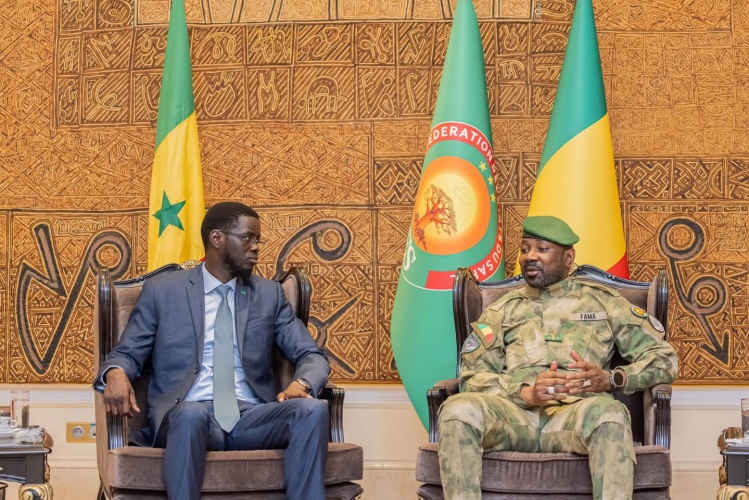
Gambiaj.com – (BAMAKO, Mali) – Senegalese President Bassirou Diomaye Faye’s visit to Bamako appears to mark a renewed effort to rebuild Senegal’s relationship with Mali, placing security cooperation and regional solidarity at the center of Dakar’s engagement with the military-led government of General Assimi Goïta.
Faye was received by Goïta during what Senegal described as a working and solidarity visit, with the two leaders reaffirming the historical and fraternal ties between their countries and expressing a desire to strengthen cooperation in the face of shared challenges.
The visit comes against the backdrop of a period of strained relations between Dakar and Bamako, despite the deep social, cultural, economic, and geographical links that bind the two countries.
A new approach to Bamako
Faye’s direct engagement with Goïta is particularly significant given Senegal’s earlier attempt to use former Prime Minister Ousmane Sonko as a key interlocutor with Mali.
Sonko was entrusted with the Mali dossier by Faye, but that engagement failed to produce the breakthrough Dakar appeared to seek and, at points, contributed to tensions between the two capitals. The relationship became increasingly complicated as Mali’s military authorities pursued a sovereignist foreign policy and distanced themselves from regional institutions and approaches associated with the Economic Community of West African States (ECOWAS).
Faye’s decision to personally travel to Bamako and engage directly with Goïta therefore suggests a recalibration of Senegal’s strategy.
Rather than relying principally on political intermediaries, the Senegalese president appears to be seeking a direct relationship with the Malian leadership, with security emerging as the most important area for rebuilding confidence.
His message in Bamako was notably conciliatory.
Faye thanked Goïta for what he described as a warm and fraternal welcome and repeatedly emphasized the historical bonds between the two countries, including their shared geography, culture, family ties, and history.
That language matters in a relationship that has recently been marked by political differences.
Security at the heart of the reset
The most consequential aspect of Faye’s visit was his emphasis on Mali’s deteriorating security situation and the threat posed by jihadist violence across the Sahel.
The Senegalese president offered condolences following recent attacks that killed Malian soldiers and strongly condemned what he described as “odious, cowardly, and barbaric” attacks.
More importantly, he told Goïta that Senegal was available to accompany Mali in confronting the security crisis.
Faye’s formulation went beyond expressing solidarity with Mali. He linked the country’s security crisis directly to Senegal’s own national and regional interests.
“The threats do not know borders and become stronger with our divisions,” Faye said, stressing the need for countries in the region to combine their efforts against terrorism.
That position potentially opens the door to a more pragmatic security relationship between Dakar and Bamako at a time when Mali’s withdrawal from ECOWAS and its increasingly independent security partnerships have complicated traditional regional cooperation.
Faye’s declaration that Goïta could count on Senegal’s “indefectible support” was therefore one of the most politically significant messages from the visit.
It suggests that Dakar is attempting to position itself not as an external critic of Mali’s military authorities but as a neighboring state willing to work with them on areas of shared strategic interest.
From political friction to pragmatic cooperation
The visit also offers Faye an opportunity to correct an earlier diplomatic miscalculation.
The Sonko-led engagement with Bamako was closely watched because of the political affinities between Senegal’s new leadership and the anti-establishment governments that had emerged in the Sahel.
Yet the expected rapprochement did not materialize.
Instead, Dakar and Bamako found themselves on opposite sides of several regional questions, particularly over the future of West African integration and the role of ECOWAS.
Faye now appears to be pursuing a different route: putting bilateral interests and immediate security concerns ahead of ideological or institutional disagreements.
His meeting with Goïta did not erase those differences. But the language used by the Senegalese president indicates an attempt to create sufficient political space for Dakar and Bamako to cooperate despite them.
That could prove particularly important for Senegal.
Mali’s instability is not a distant problem for Dakar. The two countries share a long border, while insecurity in Mali and the wider Sahel has the potential to spread towards coastal West Africa.
For Senegal, therefore, maintaining channels of communication with Bamako is not simply an exercise in diplomatic solidarity. It is also a security imperative.
UEMOA and OMVS provide another bridge.
The two presidents also discussed cooperation through regional institutions, including the West African Economic and Monetary Union (UEMOA) and the Organisation pour la mise en valeur du fleuve Sénégal (OMVS).
Faye said the two sides agreed to work with other countries to convene summits aimed at revitalizing monetary and economic cooperation, as well as the management of shared water resources along the Senegal River.
The inclusion of UEMOA is particularly noteworthy given Mali’s complicated relationship with regional integration following its withdrawal from ECOWAS alongside Burkina Faso and Niger.
By emphasizing areas of cooperation where Senegal and Mali continue to share institutional and material interests, Faye appears to be pursuing a pragmatic form of regional diplomacy: keeping channels open even where political disagreements remain unresolved.
The Senegal River, meanwhile, offers perhaps an even more concrete basis for cooperation. Its resources are shared by several countries, making coordination over water, infrastructure, and economic development a practical necessity rather than simply a diplomatic aspiration.
Can Bamako-Dakar ties be fully repaired?
Faye’s visit does not necessarily mean that all differences between Senegal and Mali have disappeared.
But it appears to represent an important attempt to move the relationship away from recent friction and towards a more pragmatic partnership.
The symbolism of the Senegalese president personally visiting Goïta, the emphasis on fraternity and shared history, and his explicit offer of Senegalese support on security all point in the same direction.
For Bamako, Dakar’s new tone provides an opportunity to strengthen relations with a neighboring country that has historically maintained close political, economic, and social links with Mali.
For Faye, it is an opportunity to reclaim a relationship that the earlier Sonko-led approach failed to stabilize.
The real test will now be whether the warmth displayed in Bamako translates into concrete cooperation on counter-terrorism, border security, intelligence sharing, economic integration, and the management of shared resources.
For now, however, Faye’s visit appears to signal that Dakar has decided that whatever its disagreements with Bamako, Senegal cannot afford a fractured relationship with its eastern neighbor at a time when the Sahel’s security crisis is moving closer to its borders.



Leave a Reply