


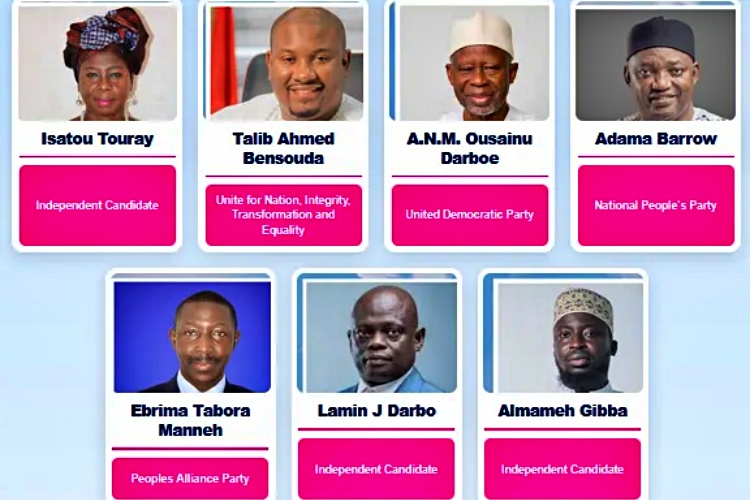
Gambiaj.com – (BANJUL, THE GAMBIA) – Almost exactly five years ago to the day, I published an article on why Gambian voters should not give President Adama Barrow a second term. In that article, I spelt out some criticisms that had been levelled against President Barrow, laid out my grudges against him and, in conclusion, I urged Gambians to vote President Barrow out in the December 2021 presidential election.
The Barrow Record: Five Years On
The criticisms against President Barrow back in October 2021 were that he failed to honor his pledge to resign from office after serving as a three-year transition President, his government selectively implemented the recommendations of the Janneh Commission which looked into former President Jammeh’s financial dealings, and that he failed to ensure adoption of the 2021 Draft Constitution of The Gambia. President Barrow was also criticized for delaying the adoption of the TRRC’s report, and for the rampant corruption under his watch.
On my part, I was upset that President Barrow had been gaining weight in office because, I suspected, he was too busy having a good time in office. In contrast, I pointed out, President Paul Kagame of Rwanda, who was too busy working to develop his country, had maintained practically the same weight after 27 years in office.
In addition, President Barrow’s party, the National People’s Party (NPP) formed an alliance with the APRC, the party of former Dictator President Jammeh to contest the December 2021 election, despite the disturbing public testimonies by victims of former President Jammeh’s atrocities at the TRRC.
Despite my call for Gambians to vote President Barrow out, he went on to win the 2021 presidential election, by a healthy margin. Furthermore, he appointed former Ministers who served former President Jammeh into his Cabinet and nominated former Jammeh diehard supporters and senior APRC officials, Fabakary Tombong Jatta, and Seedy Njie as Speaker and Deputy Speaker, respectively, of the National Assembly.
Since assuming office for his second term as President, Barrow has gone from bad to worse, at least in my judgement. He has presided over an almost three-fold increase in our national debt from $806 million in 2016 to $2.4 billion in 2025, and in the first half of 2026, government spent D3.1 billion on interest payments on debt. The education sector has also fared poorly, given the 10-year (2016–2026) average pass rate of only 5.2% of Gambian children in the West African Senior School Certificate Examination (WASSCE).
Between 2019 and 2024, President Barrow’s spending on the constitutionally mandated annual Meet the Farmers Tour was D246.2 million, 3.6 times the D69.4 million approved in the annual budgets. When, a few months ago, Gambians were enduring a terrible power supply crisis, President Barrow showed his insensitivity and incompetence by hosting a party to celebrate the victory of the English football club, Arsenal.
President Barrow now has his horde of sycophants who, because of the crumbs, privileges and perks they enjoy from his rule, are willing to go to all lengths to do his bidding. That’s what the Minister of Agriculture, Demba Sabally when he declared that they will shed blood, if President Barrow asks them to. He was not only applauded by his audience, but he remains a Minister, showing a high level of tolerance of bigotry by the Barrow administration.
The Three Leading Contenders And Their Baggage
Despite his track record, President Barrow is presenting himself as a candidate in next month’s presidential election. As he and his supporters would have you believe, his administration has done well for the country, and he should be given a third mandate. His campaign is in high gear, but all bets are off given conflicting poll results.
Earlier this month, a poll showed a clear Barrow lead, with 37.9% voters intending to vote for him (compared to 24.2% for the opposition runner up, Ousainou N. Darboe), a few days later, another poll showed a smaller Barrow lead (28%, compared to 25% for Darboe).
With less than two weeks to go before the presidential election on December 5, 2026, it is clear there will be a three-horse race between President Barrow, Darboe of the United Democratic Party in (UDP), and Talib Ahmed Bensouda of Unite for Nation, Integrity, Transformation and Equality (UNITE).
Darboe, who founded his UDP in 1996, has so far unsuccessfully contested five presidential elections, and is a bona fide member of the global league of Perennial Candidates. He probably hopes to pull off a feat similar to those achieved by Wavel Ramkalawan, leader of Seychelles National Party, and President Hakainde Hichilema of Zambia, both of whom contested elections five times before winning on the sixth attempt.
Despite the vibrancy of his campaign and the fanatical support from his party ranks, Darboe’s candidacy faces significant challenges. First, it was Darboe who vigorously defended Barrow’s decision to renege on his promise to serve a three-year transitional period. Second, the UDP has a serious image problem that simply won’t go away.
And the party is not helping itself by tolerating the likes of Yankuba Darboe, Chairman of Brikama Area Council and member of the UDP Executive Committee, who said that blood must be shed in this election. That UDP can tolerate extremists like Yankuba Darboe in its midst is, in my book, grounds for not voting for Ousainou Darboe in the December 2026 presidential election.
Talib Ahmed Bensouda is the youngest of the three leading presidential candidates and comes to the race after serving for two terms as Mayor of Kanifing Municipality, the second most populous local government area in the country. Bensouda also used to be a leading member of the UDP and only left that party after failing to be elected as their flagbearer. There thus is no love lost between Bensouda and the UDP.
Bensouda should also address other issues if, in my opinion, he is to gain any credibility with Gambian voters. First is the fact that he failed to provide a convincing narrative that he was a successful mayor. Although KMC spent D100 million on new garbage trucks, the streets of Serrekunda, and the market area, especially, are still filled to the brim with garbage.
Secondly, Bensouda failed to provide a transparent and accountable stewardship of his municipality, starting with the lack of transparency about the procurement of the garbage trucks. It is hard to see how Bensouda, who could not run a municipality transparently, competently and in accordance with the law, will provide us with a presidency that serves the interests of the people.
Third, Bensouda needs to be clear to Gambian voters whether, if he wins the election, his government will implement the recommendations of the National Assembly Special Select Committee (SSC) report on the sale and disposal of assets identified by the Janneh Commission of Inquiry into the financial dealings of former President Jammeh.
The SSC inquiry found many shortcomings in how the Janneh Commission handled the disposal of Jammeh’s assets, and Bensouda’s mother, Amie Bensouda, was found by the SSC to have a possible conflict of interest in her role as the Lead Counsel to the Janneh Commission. Will Bensouda, if he is elected president, ensure that the recommendations of the SSC are implemented, even where they do not serve the interests of his mother?
Fourth, Bensouda showed bad judgment when he expressed his support for, and visited Ousmane Sonko, a Senegalese opposition figure and former Prime Minister. Why would a Gambian presidential aspirant want to be seen to side with a Senegalese opposition politician if s/he, as can be expected, intends to have good relations with Senegal, our most important neighbor?
Bensouda’s meeting with Sonko showed his political immaturity and a lack of, or failure to heed, sound advice and suggests that he does not yet have the temperament or strategic foresight to be president of The Gambia.
A Hobson’s Choice For Gambian Voters
As things are now, the three leading contenders in the coming presidential election present Gambian voters with a Hobson’s Choice because neither of them holds any great prospects for the future of the country. And therein lies the tragedy of The Gambia: this small country of relatively peaceful people is both blessed and cursed.
As small and poor as our country is, people from almost all countries in West Africa come here to seek their fortunes or to escape the ravages of war and conflict in their countries. In the case of Senegal, for example, The Gambia accounted for $312 million of its remittances in 2021, the third largest source (after France and Italy).
But The Gambia is also a cursed country with an elite as well as a political business class which has captured the State and is bleeding it dry, leaving its people impoverished. Which is precisely why we sadly have such an uninspiring and frightening crop of presidential aspirants in 2026.
In the end, people are going to vote based on their affinity for a candidate, and not necessarily the hard facts about that candidate’s record or leadership qualities. Whoever wins, we will have to live with the consequences for the next five years.
Please pray for us.
The author, Dr. Katim S. Touray, Ph. D. Is a soil scientist, an international development consultant and a writer on sustainable development and Gobal Affairs











Leave a Reply