


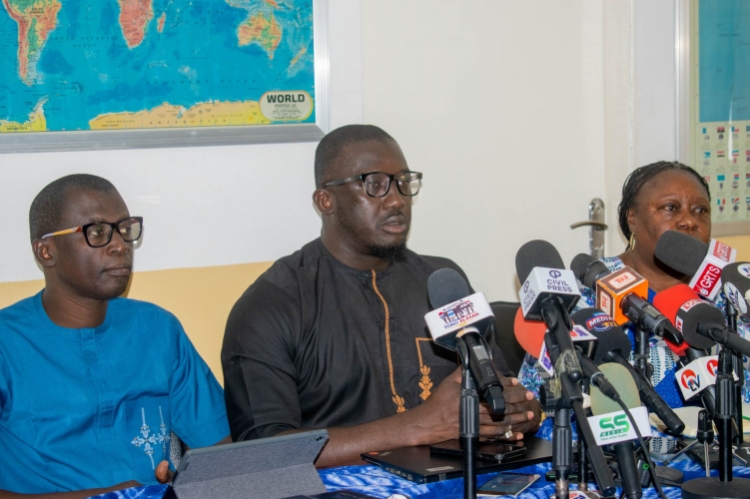
Gambiaj.com – (BANJUL, The Gambia) – The Federation of Labour Unions of The Gambia has marked International Labour Day with a strong call for comprehensive labour reforms, submitting a seven-point resolution to the government aimed at improving wages, social protection, and enforcement of workers’ rights.
The Federation, the country’s national center for trade unions, made the declaration during a press conference assessing the state of labor conditions nationwide. It described itself as a voluntary, apolitical, non-sectarian, and democratic association representing registered trade unions.
Speaking at the event, Federation President Omar Ceesay said the organization’s core mandate is to unify workers under a single platform and amplify their voice in national policymaking.
“The Federation stands on behalf of workers across The Gambia, both informal and formal, to engage government on policies that ensure minimum wages, social justice, and protections, while tackling issues such as child labor and sexual harassment in line with international labor standards,” he said.
He added that the Federation is equipped with the legal and technical expertise required to guide and advocate effectively for workers.
Treasurer of the Federation and President of the Gambia Teachers’ Union, Ismaila Ceesay, said this year’s May Day observance signals a shift from symbolic commemoration to concrete action, underscored by the formal submission of demands to the government.
“For over a century, this day has served as a reminder of the struggles and victories of the labor movement worldwide. In The Gambia, every road built, every child taught, and every harvest gathered reflects the resilience of our workforce,” he said.
Ceesay highlighted that between 70 and 80 percent of the country’s workforce operates within the informal economy, including market vendors, domestic workers, and fishers, yet remains largely excluded from protections under the Labour Act 2023. He stressed the need for inclusive reforms to extend legal coverage to all categories of workers.
He further noted that social protection in The Gambia remains among the lowest in the sub-region, pointing out that the National Social Security and Housing Finance Corporation does not currently provide unemployment benefits or adequate coverage for informal workers.
Raising concerns about workplace inequalities, Ceesay said women continue to face systemic discrimination and sexual harassment, while child labor persists in sectors such as artisanal fishing and agriculture, in violation of international standards.
The Federation’s resolution sets out seven priority reform areas: the establishment of a living minimum wage aligned with basic needs; creation of a universal social protection system; extension of labor protections to informal workers; stronger enforcement of occupational health and safety standards; advancement of gender equality and anti-harassment measures; elimination of child labor; and revitalization of social dialogue through the National Labor Advisory Council.
Ceesay called on all trade unions in the country to unite under the Federation to strengthen collective advocacy and push for improved working conditions nationwide.












Leave a Reply