


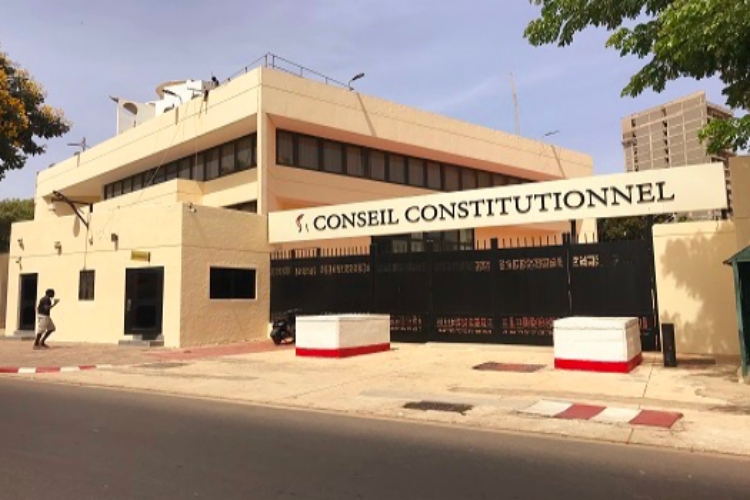
Gambiaj.com – (DAKAR, Senegal) – The Constitutional Council of Senegal has given a broadly favorable ruling on President Bassirou Diomaye Faye’s proposed constitutional revision, validating the overall direction of the reform while ordering a series of significant corrections before the draft can proceed to a parliamentary vote or referendum.
In a landmark decision numbered 4/C/2026, delivered on May 13, 2026, following a presidential referral eight days earlier, the Council, sitting under the interim presidency of Vice-President Aminata Ly Ndiaye and deliberating with six members, declared the revision initiative constitutionally admissible, confirming it had been launched outside the prohibited periods stipulated under current law.
The proposed revision touches the Preamble and approximately twenty articles of the Constitution, alongside transitional provisions in Articles 3 and 4 of the draft text.
While the Council gave the green light to the thrust of the reform, it drew firm red lines in several areas, signaling that the government must return to the drawing board on some of the most sensitive provisions.
Protecting the Untouchable
Among the Council’s most consequential directives is its demand for a complete rewriting of the Preamble’s final indent, which had referred only to the limitation of presidential mandates as constitutionally immutable.
The Council found this formulation dangerously incomplete. Under Article 103 of the Constitution, a wider array of provisions cannot be amended under any circumstances, and the Council insisted that the Preamble must explicitly protect all of them, namely, the republican form of the state and the mode of presidential election, as well as the duration and the consecutive number of terms a President may serve.
Without this correction, the Council warned, the constitutional entrenchment would remain partial and legally fragile.
The Oath That Divided
In one of its more pointed interventions, the Council struck down the expression “according to his faith” — selon sa confession — from the presidential oath provision under Article 37.
The judges ruled that introducing a religious distinction into the solemn swearing-in of a head of state runs counter to the general spirit of the Constitution, which does not differentiate between citizens on confessional grounds. The offending phrase must be removed entirely.
A Court That Cannot Give Mere Opinions
A significant legal point arose around Article 92 of the draft, which had proposed describing the rulings of the future Constitutional Court as “consultative” in nature.
The Council firmly rejected this framing. It reminded the drafters that even when the constitutional jurisdiction is consulted for an opinion, its decisions carry binding force on all public authorities and judicial bodies.
Labeling such decisions as merely advisory would, in the Council’s view, undermine the constitutional principle of legal certainty, a foundational guarantee the revision must not erode.
From Council to Court
The draft’s most symbolically charged proposal, renaming the institution from “Constitutional Council” to “Constitutional Court,” was validated in substance by the very body whose name would change.
However, the Council noted a technical reservation: the provision in Article 4 effectuating this renaming is transitional in nature, and once its purpose is accomplished, it would cease to have effect. It therefore lacks the permanence that a constitutional provision ordinarily demands.
On the future Court’s architecture, the Council recommended reformulating Article 92 to affirm that the Constitutional Court would be the highest jurisdiction in matters of constitutional review, referendums, and electoral disputes – with powers spanning the constitutionality of laws, international agreements, and even the validity of the election of the National Assembly’s bureau.
Linguistic Precision and Editorial Fixes
The Council also ordered a series of smaller but legally meaningful corrections. In the Preamble, references to African integration organizations must be reworded to avoid the impression that the Union Africaine is the sole body of its kind.
The reference to the principle of imprescriptibility must be expanded to explicitly include the universal jurisdiction of Senegalese courts. In Article 20, the word “élever” – to raise – must be replaced by “éduquer” – to educate – in the context of children’s rights.
A redundant phrase concerning the final proclamation of election results must be removed from Article 36. In Article 42, the phrasing “of Senegal” attached to the word “sciences” must be corrected to “in Senegal“. A missing comma in Article 74 must also be inserted.
A Wide Swath Passes Scrutiny
Despite its pointed objections, the Council expressly found no constitutional concerns with a substantial number of the proposed modifications, clearing Articles 4, 8, 9, 17, 18, 21, 25-1, 29, 30, 31, 34, 36, 39, 53, 54, 57, 58, 59, 61, 77, 80, 89, and 90 without comment.
This signals that the backbone of the revision survives judicial scrutiny and that the government’s reformist agenda retains solid constitutional footing.
With the Council’s decision now public, the government must incorporate all the mandated corrections before submitting the revised text to either the National Assembly or a referendum, as provided under Article 51 of the Constitution.
The ruling sets the boundaries of what Senegal’s foundational law can and cannot accommodate and places the responsibility squarely on the executive and legislature to honor them.







Leave a Reply