


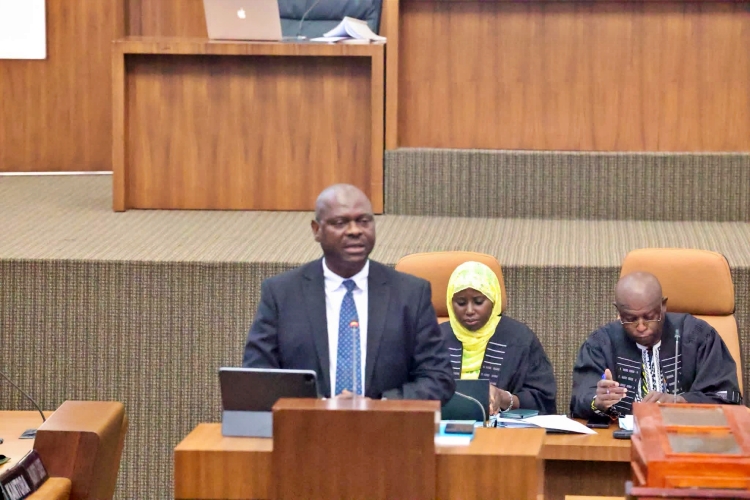
Gambiaj.com – (BANJUL, The Gambia) – The Government of The Gambia spent D1.36 billion on debt servicing during the first three months of 2026, according to Finance and Economic Affairs Minister Seedy Keita, who said the expenditure reflected scheduled debt obligations rather than any budget implementation difficulties.
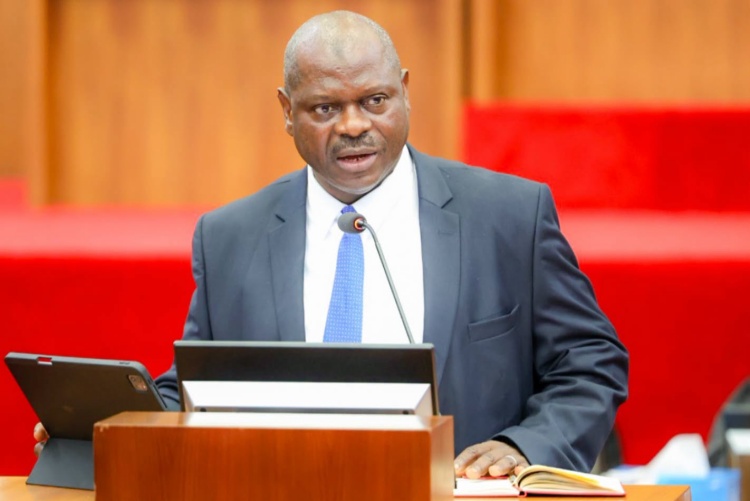
Presenting an oral ministerial statement on the implementation and monitoring of the 2026 National Budget before the National Assembly, Minister Keita disclosed that national debt service recorded an outturn of D1.36 billion in the first quarter, representing a 10.1 percent execution rate.
“This reflects the timing of scheduled debt repayment obligations and should not be read as an implementation challenge,” the minister told lawmakers.
The debt servicing expenditure formed part of the overall Gambia Local Fund (GLF) expenditure and net lending, which reached D7.87 billion during the first quarter, representing 22 percent of the approved annual budget.
According to the minister, personnel emoluments, subsidies, and transfers to subvented institutions and debt servicing costs were the main drivers of government spending during the period.
Personnel emoluments accounted for D2.45 billion, while subsidies and transfers amounted to D2.14 billion. Debt servicing costs stood at D1.36 billion.
Despite the substantial expenditure, government finances recorded a deficit of D195.84 million in the first quarter, significantly lower than the budgeted deficit of D615.44 million. The figure represents a 68 percent reduction from the projected deficit and was D391.41 million lower than the deficit recorded during the same period in 2025.
Current expenditure reached D7.13 billion, representing 20 percent of the approved annual allocation of D36.18 billion. This was D149.96 million, or 2 percent, higher than the expenditure recorded during the corresponding period last year.
Capital expenditure amounted to D738.74 million, accounting for 21 percent of the approved annual budget of D3.54 billion. However, this was D409.18 million lower than capital spending recorded in the first quarter of 2025.
Sectoral spending data showed that the Ministry of Basic and Secondary Education was among the largest spenders during the quarter, posting an execution rate of 25.79 percent. Expenditure was driven by salaries, school feeding programs, school improvement grants, and textbook printing.
The Ministry of Agriculture recorded the highest execution rate at 43.03 percent, supported by D450 million in groundnut subsidies, D177.4 million in agricultural input subsidies, and the purchase of 90 tractors valued at D35 million.
The Ministry of Health registered an execution rate of 21.01 percent, while the Ministry of Interior spent 23.31 percent of its approved budget during the reporting period.
Meanwhile, the Ministry of Transport, Works, and Infrastructure recorded an execution rate of 24.55 percent, largely driven by contractor payments exceeding D652 million for ongoing road and construction projects.
At the lower end of the spending scale, the Ministry of Petroleum and Energy recorded the lowest execution rate at 1.02 percent, largely because no expenditure had yet been incurred under the D1 billion energy subsidy allocation.
The Ministry of Public Service, Administrative Reforms, and Policy Coordination registered an execution rate of 6.42 percent, while Centralised Services recorded a 13.23 percent execution rate, driven primarily by a D80 million subsidy to NAWEC and D60.5 million allocated to the settlement of confirmed debts.
Minister Keita said the first-quarter figures demonstrate continued implementation of the 2026 National Budget while maintaining fiscal discipline and keeping the budget deficit well below projected levels.










Leave a Reply