


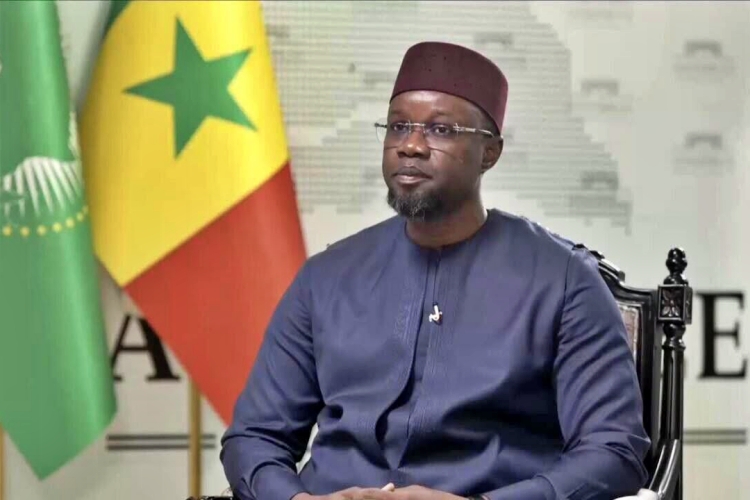
Gambiaj.com – (DAKAR, Senegal) – The power struggle between President Bassirou Diomaye Faye and Prime Minister and National Assembly President Ousmane Sonko has taken a new turn, with Sonko moving to take control of a constitutional reform process that was originally initiated by the head of state.
Political tensions within Senegal’s ruling establishment have intensified in recent weeks, with local media describing relations between the executive branch led by President Faye and the legislature dominated by Sonko as having shifted from a “cold war” to an increasingly open confrontation.
The latest dispute centers on a package of constitutional reforms launched by President Faye.
Seeking to ensure that the proposed amendments complied with constitutional requirements, the president had earlier referred the initiative to the Constitutional Council of Senegal for legal guidance and opinion.
However, before the presidency could formally advance the process, Sonko moved to place himself at the center of the initiative.
According to Senegalese media reports, Sonko informed the bureau of the National Assembly that a bill would be tabled which, according to him, would incorporate the observations and recommendations made by the Constitutional Council into the constitutional reforms originally proposed by President Faye.
The move is widely viewed as an attempt by Sonko to assume political ownership of a reform process initiated by the president while ensuring that the National Assembly, where his allies hold an overwhelming majority, becomes the principal vehicle for driving the amendments forward.
Lawmakers aligned with Sonko have already converted the president’s reform project into a parliamentary bill, a step seen by critics as an effort to bypass the initial executive-led process and transfer control of the initiative to the legislature.
In parallel, Sonko requested an advisory opinion from President Faye on the proposed constitutional amendments. The president has until June 22 to respond.
Yet Sonko has already convened another meeting of the Assembly bureau for June 24 to establish a timetable for examining the proposals should no response be received by then, reinforcing perceptions that the legislative process will continue regardless of the president’s position.
For many political observers, the sequence of events suggests that Sonko is determined to use his dual influence over the government and parliament to impose his preferred legislative agenda, even when dealing with reforms conceived and initiated by President Faye himself.
The developments add to the open infighting and competition for authority within the ruling Pastef party, whose two most prominent leaders swept to power on a joint ticket but now appear increasingly divided over the exercise of power.
The controversy has also sparked calls for transparency.
Speaking on Saturday, June 20, civil society’s prominent figure Babacar Ba questioned the status and content of the opinion sought by Sonko from President Faye regarding the constitutional revision proposal.
“The transparency requirement means that the Senegalese people, who are sovereign, must be clearly informed of the position of the President of the Republic on the proposed constitutional revision law submitted to him for opinion by the National Assembly,” Ba said in a statement.
As the June 22 deadline approaches, attention is now focused on whether President Faye will publicly endorse the parliamentary initiative or resist what many see as an effort by Sonko to take command of a constitutional reform process that began at the presidency but is increasingly being steered from the National Assembly.





Leave a Reply