


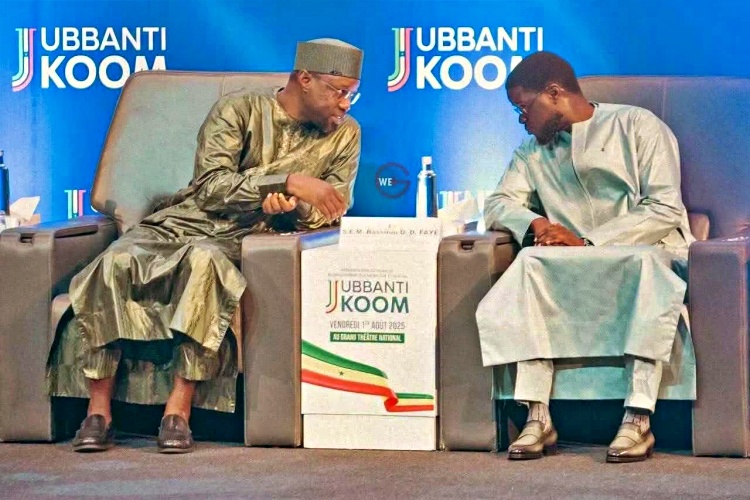
Gambiaj.com – (DAKAR, Senegal) – Senegal’s deepening institutional standoff between President Bassirou Diomaye Faye and National Assembly Speaker Ousmane Sonko has moved into a new phase, with the executive challenging Parliament’s attempt to regulate the special credits placed at the discretion of the head of state.
The government on Tuesday, August 18, asked the Constitutional Council to declare inadmissible a proposed law seeking to establish a legal framework for special credits, setting the stage for a major constitutional test over the respective powers of Parliament and the executive.
The move comes less than 24 hours before the bill is due to be considered by the National Assembly, where Sonko’s PASTEF holds a dominant majority. PASTEF won 130 of the 165 parliamentary seats in the November 2024 legislative elections, giving Sonko considerable leverage over the legislative agenda.
Sonko Targets Presidential Discretion
At the center of the dispute are special credits, funds that the executive can mobilize for matters requiring confidentiality, urgency, or flexibility, including national security, sensitive social interventions, emergencies of national interest, and regional solidarity.
Sonko has made the regulation of these funds a political and institutional priority, arguing that they require greater transparency and parliamentary oversight. His parliamentary majority is now being used to advance legislation that could significantly constrain the president’s discretion over the funds.
The initiative has particular political significance because Sonko himself occupied the position of prime minister under President Faye and had access to the same financial mechanisms he is now seeking to regulate until his dismissal from the government.
That creates an obvious political contradiction at the heart of the dispute: funds whose use is now being portrayed by Sonko and his political camp as requiring stronger legal restrictions were also available to the Prime Minister’s office when Sonko was in government.
The government’s resistance therefore goes beyond a technical disagreement over budgetary procedure. It is also a contest over how much financial discretion should remain with the presidency and whether Parliament can, through ordinary legislation, substantially redefine the executive’s ability to respond to confidential or urgent matters.
From “Haram” to Legislative Reform
Sonko has previously taken a hard line against what he described as opaque or politically controlled funds. But once, he became Prime Minister and began enjoying the funds, he first claimed he never had any before he admitted to having over a billion and half CFA of them.
In a recent media intervention, he claimed that more than three billion CFA francs had been “pumped” from special-fund accounts at the Prime Minister’s Office before he took office.
He said his Directorate of Administration and Equipment raised questions about the accounts after his arrival and that he sought explanations from former Finance Minister Cheikh Diba.
Sonko also called for greater transparency and an audit of political and special funds.
However, the allegations have been challenged by Macodou Sène, who served as DAGE of the Prime Minister’s Office during the period referenced by Sonko.
Sène has categorically denied managing unexplained or unaccounted-for special funds and challenged Sonko to produce documentary evidence supporting his claims.
“I did not manage funds that had no supporting documents,” Sène said on TFM, insisting that he had never managed political or special funds that were spent without accountability.
That unresolved dispute now forms part of the political backdrop to Sonko’s campaign to impose a new legal framework on the funds.
The controversy is particularly sensitive because the argument has shifted from whether the funds should be considered legitimate instruments of government to whether the legislature should determine the conditions under which the executive may use them.
Executive Pushback
President Faye’s government is now fighting back through constitutional means rather than attempting to defeat the bill through parliamentary arithmetic.
According to the Prime Minister’s Office, the National Assembly placed the proposed law on special credits on the agenda of its first extraordinary session of 2026 under an emergency procedure. The bill was examined rapidly in committee and scheduled for plenary consideration on Wednesday, August 19.
The government objected to the bill on constitutional grounds, arguing that some of its provisions fall within the regulatory domain reserved for the executive.
The Office of the Prime Minister invoked Articles 67 and 76 of the Constitution in opposing the bill’s admissibility. It has now taken the dispute to the Constitutional Council under Article 83, paragraph 2 of the Constitution, as reflected in Article 69, paragraph 8 of the 2025 organic law governing the National Assembly.
The Council is therefore being asked to determine whether Parliament has crossed the constitutional boundary between matters that belong to legislation and those reserved for executive regulation.
A Test of Institutional Balance
The dispute places Senegal’s post-2024 political arrangement under renewed pressure.
Faye and Sonko came to power as political allies after running on a shared promise to break with the practices of previous administrations.
But the relationship between the president and his former prime minister has progressively deteriorated, with disagreements increasingly extending into the institutional balance between the presidency, government, and Parliament.
The special-credits dispute now gives that rivalry a concrete constitutional dimension.
For Sonko, regulating the funds offers an opportunity to impose greater parliamentary scrutiny over resources traditionally associated with executive discretion. For Faye’s government, allowing Parliament to legislate extensively in this area could establish a precedent that limits the presidency’s ability to act quickly when confidentiality or urgency is required.
The government’s position is not that the funds should necessarily remain beyond all scrutiny. Rather, its immediate argument is that Parliament cannot regulate an area that the Constitution assigns to the regulatory authority of the executive.
That distinction is crucial because the Constitutional Council’s decision could determine whether the dispute is fundamentally about transparency or about the constitutional separation of powers.
What Is at Stake
The immediate question is whether the proposed law can proceed to a parliamentary vote on August 19. But the implications are considerably broader.
A ruling against the government could strengthen the Assembly’s ability to legislate around the executive’s discretionary financial powers and give Sonko’s parliamentary majority a new instrument for scrutinizing presidential spending.
A ruling in favor of the executive, meanwhile, would reinforce the president and government’s constitutional authority over areas considered to fall within the regulatory domain and could prevent Parliament from using ordinary legislation to restrict those powers.
The Constitutional Council’s arbitration therefore comes at a politically delicate moment.
Sonko is using the parliamentary majority that emerged from the 2024 elections to challenge a financial mechanism he has long criticized but fully enjoyed until his dismissal from the government. Faye’s executive is responding by arguing that the challenge itself may constitute a constitutional overreach.
The Council’s ruling could determine not only the fate of the special credits bill but also the limits of the power struggle between President Faye and Speaker Sonko.





Leave a Reply