


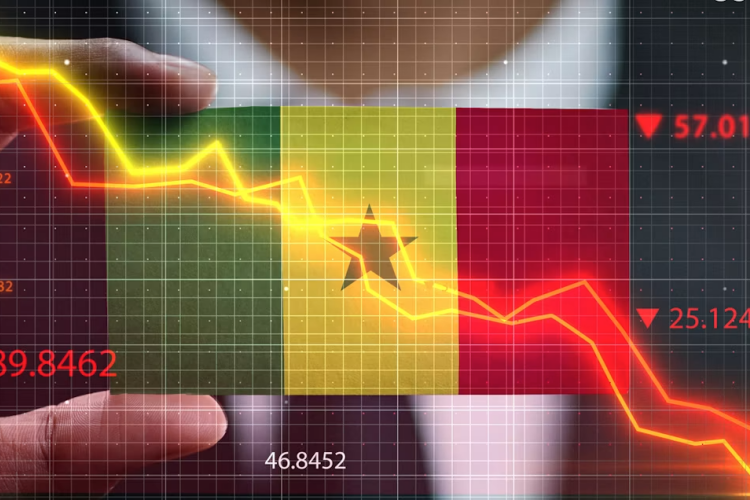
Gambiaj.com – (DAKAR, Senegal) – Senegal has moved closer to a potential default after Moody’s Ratings downgraded the country’s sovereign credit rating from Caa1 to Caa2, citing acute liquidity pressures, rising debt costs, political instability, and limited prospects for reducing the country’s debt burden.
The ratings agency announced the downgrade on Friday, August 28, while maintaining a negative outlook, signaling that Senegal could face further downward pressure if its financial and political difficulties worsen.
Moody’s said the downgrade of Senegal’s long-term foreign and local currency issuer ratings and foreign currency senior unsecured ratings reflected “rising refinancing pressures, weakening debt affordability and limited prospects for debt reduction” that have increased the likelihood of a default event.
Acute Financing Pressures
Senegal faces particularly severe liquidity risks, with gross financing needs projected at around 25 percent of rebased GDP in 2026.
According to Moody’s, the prolonged absence of an active International Monetary Fund program has forced the government to depend heavily on regional market borrowing, commercial facilities, and residual World Bank support.
The country has already issued regional market debt equivalent to around 8 percent of GDP since the beginning of the year, increasing its exposure to rollover risks and costly borrowing.
Interest payments have surged to 23.7 percent of government revenue, compared with 16.1 percent in 2023, significantly reducing the government’s fiscal room to finance public services and development programs.
Debt Expected to Remain Near 100% of GDP
Although Senegal’s fiscal deficit narrowed considerably in 2025, largely because of cuts in capital expenditure, Moody’s warned that weaker economic growth and higher subsidy costs would continue to weigh heavily on public finances.
The agency expects government debt to remain around 100 percent of GDP through 2028, even if authorities implement sustained fiscal adjustment measures.
This raises concerns about Senegal’s ability to place its debt on a sustainable downward path while simultaneously meeting substantial annual financing requirements.
Sonko Dismissal Adds Political Risk
Moody’s also pointed to worsening institutional tensions following the dismissal of former Prime Minister Ousmane Sonko and his subsequent election as President of the National Assembly.
The development has intensified the political divide between the executive and legislative branches, raising the possibility that disagreements could delay critical fiscal reforms needed to address Senegal’s mounting debt and financing problems.
The political stalemate comes at a particularly sensitive moment, as the government faces pressure to restore investor confidence, secure sustainable external financing, and implement measures aimed at controlling debt.
Default Risk Now Highly Elevated
A Caa2 rating places Senegal deep within Moody’s speculative-grade category and indicates a highly elevated risk of a default event.
Moody’s said the rating level was consistent with a possible debt treatment primarily aimed at relieving immediate liquidity pressures. Such restructuring could involve losses for private-sector creditors, with the agency broadly associating this type of default scenario with losses of between 10 and 20 percent.
The agency also lowered Senegal’s local currency country ceiling to B1 from Ba3 and its foreign currency country ceiling to B2 from B1. Senegal’s short-term issuer ratings were affirmed at Not Prime.
The downgrade adds to a series of negative assessments from international ratings agencies. S&P Global Ratings currently rates Senegal at CCC+, following concerns triggered by the discovery of previously unreported debt liabilities from past administrations.
Those revelations, uncovered by Senegal’s Court of Auditors, exposed significantly larger debt obligations than previously disclosed and continue to cast a shadow over the country’s public finances.
With financing needs rising, borrowing costs climbing and political tensions threatening fiscal reforms, Senegal now faces increasing pressure to restore confidence among international lenders and secure a sustainable path out of its debt crisis.









Leave a Reply