



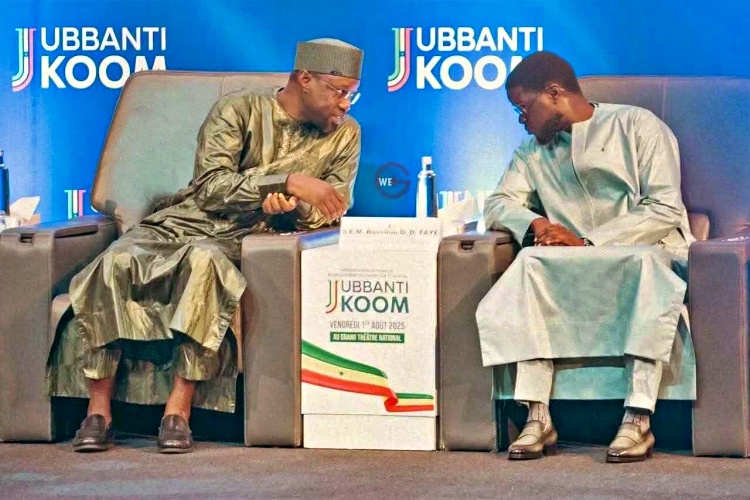
Gambiaj.com – (DAKAR, SENEGAL) – Less than 24 hours after Ousmane Sonko marshaled his PASTEF legislative majority to vote down the 2027 draft budget and denounce the International Monetary Fund (IMF) from the rostrum of the National Assembly, President Bassirou Diomaye Faye has answered with an executive counterstrike.
In a formal communiqué signed on Thursday, November 19, 2026, by Minister and Secretary-General of the Presidency Oumar Samba Ba, the Head of State invoked his constitutional mandate as “guardian of the Constitution and guarantor of the regular functioning of public authorities as well as the continuity of the State” to enact the 2026 supplementary budget (loi de finances rectificative — LFR) by decree (Decree No. 2026-2416).
The move directly overrides the National Assembly’s November 3 rejection of the revised 2026 financial bill and signals that the presidency will no longer allow Sonko’s parliamentary blockade to hold Senegal’s public finances—or its $2.2 billion IMF lifeline—hostage.
Neutralizing Sonko’s Legislative Chokehold
By enforcing the 2026 supplementary budget by decree, Faye has stripped Sonko of his most immediate point of leverage.
Over the past month, the National Assembly speaker had turned budget deliberations into an arena of institutional attrition, rejecting both the 2026 revisions (109 votes to 20) and the 2027 draft budget report on Wednesday (with only 18 deputies voting in favor) under the guise of protecting parliamentary sovereignty against IMF “interference.”
Decree No. 2026-2416 breaks that paralysis on two fronts.
Enacting the 2026 supplementary budget, which adjusts fiscal targets to a 7.6% GDP deficit while doubling family security stipends (bourses de sécurité familiale) to 70 billion FCFA, allows the executive to legally execute year-end spending and satisfy baseline IMF requirements for a credible fiscal framework without waiting for legislative blessing.
Under Article 68 of the Senegalese Constitution, parliament has a strict 60-day window from the October 12 tabling of the 2027 finance bill, expiring around December 11, to adopt a budget.
Thursday’s decree establishes a clear template: if Sonko’s majority maintains its blockade past the constitutional deadline, Faye is prepared to govern and pay state obligations by executive decree rather than capitulate to parliamentary extortion.
The “Motion de Censure” Trap
Faye’s assertion of executive authority leaves Sonko with a shrinking set of retaliatory option, chief among them, tabling a motion de censure (vote of no confidence) under Article 86 of the Constitution to topple Prime Minister Ahmadou Al Aminou Lô’s cabinet.
Yet constitutional experts in Dakar point out that triggering a no-confidence vote carries a severe structural catch that could actually strengthen Faye’s hand and box Sonko in for the rest of the legislative year.
Under Article 86 of the Constitution, once the National Assembly votes on a parliamentary-initiated motion de censure, deputies are barred from filing another during the same ordinary session, which in Senegal runs as a single continuous session from October through late June.
Even if Sonko’s PASTEF majority succeeds in passing a censure motion and forcing the formal resignation of the government, the Constitution places no restriction on whom the president appoints next.
Legal analysts note that Faye could immediately reappoint the exact same Prime Minister and re-conduct the identical cabinet lineup.
Such a maneuver would turn Sonko’s ultimate legislative weapon into a Pyrrhic victory: the government would remain intact, while PASTEF lawmakers would have exhausted their single ordinary-session censure bullet, leaving Sonko stripped of his primary threat to bring down the executive until the following parliamentary session, all while the December 2 window for Faye to constitutionally dissolve the National Assembly draws closer.








Leave a Reply