


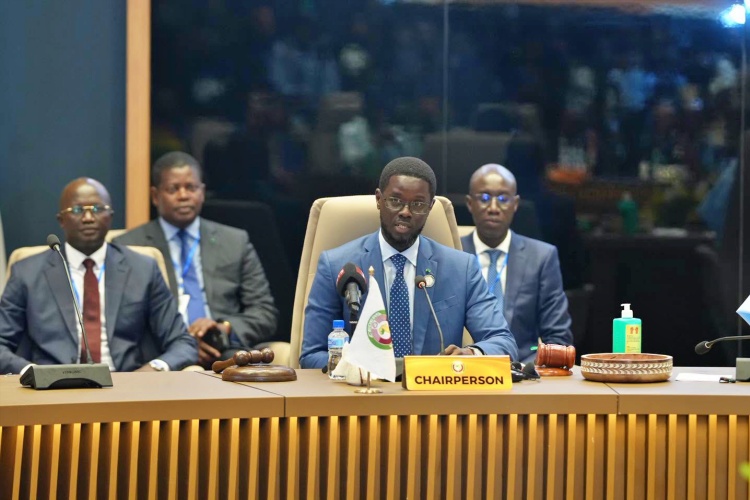
Gambiaj.com – (LUNGI, Sierra Leone) – Senegal’s President Bassirou Diomaye Faye has been elected Chairman of the Authority of Heads of State and Government of the Economic Community of West African States (ECOWAS), succeeding Sierra Leone’s President Julius Maada Bio at a time when the regional bloc faces some of the most difficult challenges in its nearly 50-year history.
Faye was elected during the 69th Ordinary Session of the ECOWAS Authority held in Lungi, Sierra Leone, bringing to an end President Bio’s one-year tenure as chair of the 15-member regional organization.
The Senegalese leader now assumes responsibility for steering ECOWAS through a period marked by political transitions, security threats, economic pressures, and strained relations with member states that have exited the bloc.
A Full In-Tray of Regional Crises
As the new ECOWAS chairman, President Faye inherits several high-priority dossiers that dominated President Bio’s leadership.
Foremost among them is the fractured relationship between ECOWAS and Burkina Faso, Mali, and Niger, which formally withdrew from the regional bloc to establish the Alliance of Sahel States (AES).
The future of engagement with the three military-led governments remains one of the most pressing issues facing ECOWAS, particularly on regional security, trade, and the free movement of people.
The new chairman is also expected to prioritise the restoration of constitutional order in countries under military rule, including Guinea-Bissau, while supporting ongoing democratic transitions across the region.
Another major challenge will be tackling the growing threat of terrorism and violent extremism, particularly in the Sahel and coastal West Africa, where insecurity continues to undermine stability and economic development.
Economic Integration and Regional Unity
Beyond security, Faye is expected to push forward ECOWAS’ long-standing agenda of regional economic integration, including improving intra-regional trade, strengthening cross-border infrastructure, and enhancing cooperation among member states.
The regional bloc also faces the task of maintaining unity at a time of increasing geopolitical competition and differing political priorities among its members.
President Bio’s tenure was characterized by efforts to strengthen regional cooperation, promote democratic governance, and coordinate responses to the security and political challenges confronting West Africa.
Leadership Transition
The election of President Faye marks a significant transition for ECOWAS, with the Senegalese leader now expected to build on the work undertaken during President Bio’s chairmanship while charting a new course for the organization.
His appointment comes as regional leaders seek to reinforce ECOWAS’ role as the leading institution for promoting peace, democracy, economic integration, and collective security in West Africa amid an increasingly complex regional landscape.
Faye’s leadership will be closely watched as the bloc seeks to rebuild trust among its members, address persistent security threats, and preserve regional cohesion in the face of evolving political and economic challenges.




Leave a Reply