


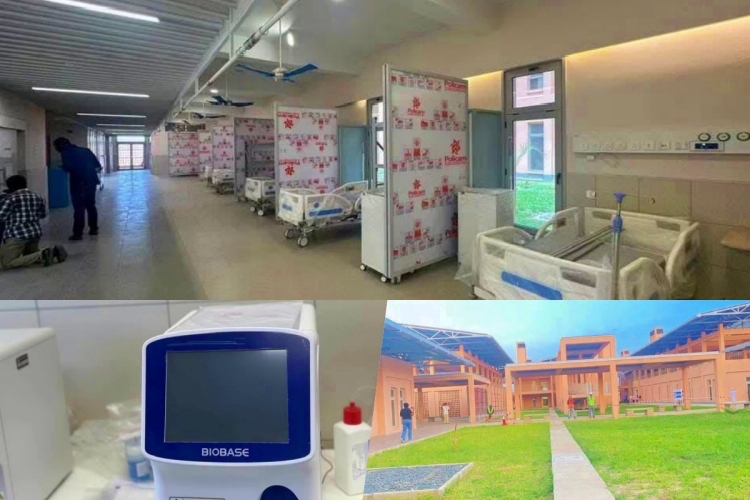
Gambiaj.com – (BANJUL, The Gambia) – On Saturday, 27 June 2026, I sat in Farato, watching a dream of national service become reality before my eyes. President Adama Barrow had come to officially open the Farato Hospital; dignitaries had gathered, and the atmosphere was one of celebration and gratitude. Yet while my body remained in Farato, my soul had quietly begun another journey.
The familiar voice of Jaliba Kuyateh drifted across the gathering. For me, it was more than entertainment. Jaliba has long occupied a special place in my memory. He was almost like a son to my late parents from the earliest days of his musical journey, when he was still a student and his talent was only beginning to take flight.
Over the years, I often told him that among his songs, three remained closest to my heart: Tereto, Kairo, and Kunkoto.
As he performed, something within me shifted. The sound remained outside me, but my mind had turned inward. I was no longer fully at Farato.
I could see my parents before me: my father’s quiet stillness, my mother’s calm presence beside him. No words, only presence, as though memory itself had briefly become reality.
Perhaps that is why the song stirred something so deep within me. In its call for patience and quiet endurance, I could still hear the lessons my parents had lived rather than spoken.
They were reminding me of something deeper: the meaning of Kunkoto. Remain calm. Hold your peace. Endure life’s struggles with dignity. Kunkoto speaks of quiet endurance. It calls for steadiness in difficult seasons and trust that hardship does not last forever.
As I sat there, another thought surfaced, one I had carried before but now saw with greater clarity: the harvest never lies. The message of Kunkoto and the truth of the harvest are the same at their core. What is planted in sincerity is never lost. What is done in silence is never wasted. Time may delay recognition, but it does not erase what has been sown.
Sitting at Farato, I realized I was not only witnessing an inauguration. I was witnessing a harvest.
I particularly appreciated that, in his address, President Adama Barrow acknowledged the many individuals and institutions whose efforts had helped bring the project to fruition.
Such recognition matters because it reminds us that no national achievement is the work of one person alone. And when such words come from the President, they carry a meaning larger than the individual moment; they become, in a sense, an expression of the appreciation that many well-meaning Gambians feel for all those whose quiet labor makes national progress possible.
I could not help but remember that when the foundation stone for this hospital was laid, there were many doubting voices. Some questioned whether the project would ever move beyond the ceremonial turning of the sod. Others dismissed it as another promise that would never take shape.
Perhaps every great undertaking passes through a season of doubt before it reaches its season of fulfillment. Now that the hospital stands completed and its doors have been opened, the narrative in some quarters has shifted. The conversation is no longer about whether it would be built but about who should receive the credit for its construction.
Perhaps this, too, is part of the human condition. We sometimes move too quickly from doubt to ownership of the narrative.
Yet national achievements need not be diminished by such debates. Farato Hospital exists today because vision, political commitment, professional dedication, and development partnership came together.
The Government of The Gambia and the World Bank each played indispensable roles, and within the World Bank, the commitment and leadership of Sam L. Mills, who served as Task Team Leader during the project’s formative period, deserve particular recognition.
So too do the many individuals whose names may never be publicly known. The harvest belongs to all who sowed the seeds.
Public service teaches us that we do not always live to see the full harvest of what we plant, but that does not lessen the value of the planting.
A hospital does not begin on the day it is opened. It begins in unseen years: ideas are formed, sacrifices are made, and efforts are sustained when no applause is present. It is built by those whose labor rarely enters the record of celebration. We celebrate the tree and forget the roots. Yet it is the roots that hold everything in place.
Roots do not seek attention. They do not resist the darkness. They simply hold fast until the tree appears above the ground. Human life carries the same truth. Some seasons are not for recognition. They are for formation.
Some silences are not absences. They are working, and we cannot yet see. As I reflected on Kunkoto, I understood again that not everything is meant to be understood while it is unfolding.
My thoughts returned to my parents, not as voices speaking but as presence remembered. They never taught through explanation alone but through a way of living that remains long after words fade. What they left behind were roots. Perhaps that is why my soul traveled that afternoon.
The inauguration of Farato Hospital was a moment of national celebration. Yet within me it became something quieter: a reminder that what is seen rests upon what is unseen, what is celebrated rests upon what is endured, and that nothing planted in sincerity is ever truly lost.
One day every title will pass to another person. Every office will change hands. The applause of today will fade into silence. What remains are the seeds we planted and the manner in which we carried ourselves through each season.
As the music continued, I sat still with gratitude and with a silence that needed no explanation.
Remain calm.
Hold your peace.
Trust the journey.
For the harvest never lies.
And sometimes, when we sit beneath the shade of a great tree, the soul does not travel far; it simply returns to the roots.
As I left Farato that evening, I carried no sense of triumph or regret, only gratitude for having witnessed one more reminder that seeds planted in sincerity eventually find their season. Perhaps every season of patient labor carries within it the promise of a harvest yet to come, for the Author of the seasons has already written ease into the very fabric of hardship.
“Indeed, with hardship comes ease. Indeed, with hardship comes ease.”
(Surah Ash-Sharh, 94:5–6).






Leave a Reply