


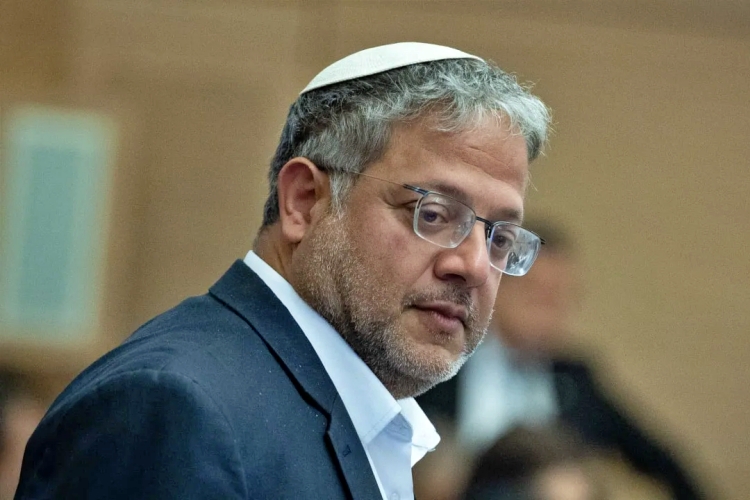
Gambiaj.com – (WASHINGTON, United States) – Israel’s National Security Minister Itamar Ben Gvir has been forced to cancel a planned trip to the United States after the American embassy subjected him to an unusual and humiliating visa condition, requiring him to present himself in person and provide his fingerprints before any travel document could be issued.
The incident has reignited global scrutiny of one of the most controversial figures in Israeli politics, a man whose criminal record stands in stark contradiction to the ministerial office he holds.
The episode, first reported by Israeli Channel 13 on Monday, lays bare the extraordinary diplomatic tension between Washington and a senior member of Prime Minister Benjamin Netanyahu’s far-right coalition government.
A Visa Process Unlike Any Other
For most Israelis, traveling to the United States is routine. Under the Electronic System for Travel Authorization (ESTA), Israeli nationals are eligible for visa-free entry to the US, provided they meet basic conditions, chief among them having no criminal record. Ben Gvir does not meet that condition.
Rather than quietly declining his application, US Embassy officials required him to report in person and submit his fingerprints, a standard procedure applied to individuals with criminal backgrounds who seek American visas.
Washington’s fingerprint demand signals deep discomfort with Ben Gvir, a man with at least 13 criminal convictions, including support for a designated terror group.
The requirement was widely interpreted as a signal that Washington was not inclined to grant him entry at all. According to Channel 13, the unusual demand was directly linked to his criminal convictions.
Ben Gvir did comply, turning up at the embassy and submitting to an interview and fingerprinting. But he ultimately cancelled the trip entirely, telling associates he feared the visa would not be approved in time for his scheduled flight.
His office, seeking to downplay the matter, stated that he had voluntarily waived his right to a diplomatic passport since most of the trip was personal in nature and had instead applied for a standard tourist visa.
The explanation, however, raised more questions than it answered. It failed to account for why he ultimately did not travel at all, and why he falsely claimed, in an apparent attempt at deflection, that all Israelis applying for US visas are required to provide fingerprints.
That claim is demonstrably false. Under the ESTA program, Israelis with clean records travel freely to the United States without any such requirement.
A Trip Mired in Controversy from the Start
Even before the visa complications emerged, the planned visit had already attracted ethical scrutiny at home.
Reports surfaced that the cost of the trip, running into tens of thousands of Israeli shekels, was set to be covered by a business associate of Ben Gvir named Yaakov Elharar, an Israeli businessman based in Miami whose daughter’s wedding Ben Gvir and his wife were attending.
The arrangement was referred to Israel’s State Comptroller Permits Committee, the body tasked with overseeing ethical conduct and conflicts of interest among public officials. The committee ruled against allowing Elharar to foot the bill for the minister’s travel.
Adding to the contradictions, Ben Gvir had also approached the Jerusalem Magistrate’s Court to postpone a defamation hearing, a case he himself had brought against a journalist, citing the US trip as a visit of “diplomatic importance.” That framing stands in direct conflict with his office’s subsequent claim that the visit was largely personal.
Who Is Itamar Ben Gvir?
To understand why the United States treated its Israeli counterpart’s security minister in a manner normally reserved for persons of concern, one must understand who Itamar Ben Gvir is and what he has done.
Born in 1976 in Mevaseret Zion, a suburb west of Jerusalem, Ben Gvir grew up politically in the orbit of Kahanism, the movement founded by Rabbi Meir Kahane that called for the expulsion of Arabs from Israel and was later designated a terrorist organization in both Israel and the United States.
His political radicalization began early. He first came to infamy as a teenager when he stole the Cadillac emblem from the car of Prime Minister Yitzhak Rabin, telling a camera crew at the time: “Just as we got to his car, we’ll get to him too.” Within weeks, Rabin had been assassinated.
Ben Gvir has accumulated at least 13 criminal convictions, including offenses related to supporting a terror organization, terrorist propaganda, interfering with police officers, and participation in illegal gatherings.
He was convicted of incitement to racism, interfering with a police officer performing his duty, and support for a terrorist organization, specifically Meir Kahane’s Kach movement, which has been banned in Israel.
During the 2000s, Ben Gvir faced dozens of charges, most of which resulted in acquittal or dismissal. His confirmed convictions included incitement of racism and support for a terrorist organization. After earning a law degree in 2008, the Israel Bar Association initially prevented him from taking the bar exam because of his criminal convictions. He later challenged that decision and was eventually admitted to the bar.
Before his appointment as a government minister, a picture of Baruch Goldstein, who stormed the Cave of the Patriarchs in Hebron during Ramadan prayers in February 1994 and opened fire on Palestinian worshippers, killing 29 before survivors beat him to death, was displayed on the wall of Ben Gvir’s living room.
A portrait of a convicted mass murderer in a politician’s home would be a career-ending detail in most nations. It was just one of many facts that shaped Ben Gvir’s political character during decades of far-right activism.
His criminal record stems from activities between the late 1990s and 2007, involving incidents such as carrying signs stating “Kahane was right” and chanting “Death to Arabs.”
Despite all of this, the Attorney General noted that the time elapsed since his last conviction in 2007 exceeded the seven-year disqualification period required by Israeli Basic Law for holding public office, paving the way for his appointment as Israel’s Minister of National Security in December 2022.
A Minister Who Controls National Security
The irony of a man with convictions for supporting a terror organization now serving as a country’s National Security Minister has not been lost on observers.
So sensitive has his criminal background become within Israel itself that police recently moved to discipline an officer who publicly called Ben Gvir a “convicted criminal,” a characterization that is factually accurate and officially documented across 13 separate convictions.
Ben Gvir has continued to court controversy in office. He has been accused by senior Israeli police officials of inflaming tensions between Jewish and Arab communities; has staged provocative political performances in sensitive locations, including East Jerusalem; and has shared inflammatory content on social media.
His party, Otzma Yehudit — or Jewish Power — is ideologically rooted in the same Kahanist tradition that inspired the banned Kach terror movement.
Washington Sends a Message
The fingerprint episode may not have produced a formal visa denial, but the message from Washington was unmistakable. By declining to simply issue a visa through normal diplomatic channels, and instead subjecting Ben Gvir to a process designed for individuals with criminal backgrounds, the United States quietly but firmly communicated its discomfort with his presence on American soil.
For a man who holds one of the most powerful security positions in the Israeli government, being unable to enter the world’s most influential democracy as a regular traveler is a sobering diplomatic reality, one that speaks volumes about the international standing of Israel’s increasingly embattled far-right coalition.
Ben Gvir has not publicly commented on whether he intends to reattempt the trip.












Leave a Reply