


Gambiaj.com – (WASHINGTON, United States) – The U.S. Supreme Court on Tuesday dealt a major setback to President Donald Trump’s immigration agenda, ruling 6-3 that his executive order restricting birthright citizenship is unconstitutional.
In a decision that reaffirms the long-standing interpretation of the 14th Amendment, the court held that children born on U.S. soil are automatically entitled to American citizenship, regardless of their parents’ immigration status.
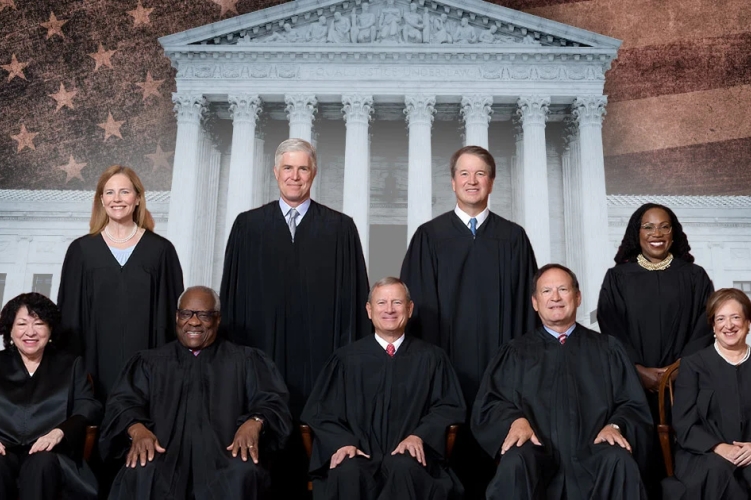
Chief Justice John Roberts authored the majority opinion, joined by the court’s three liberal justices and Justice Amy Coney Barrett. Roberts rejected the administration’s argument that the Constitution does not guarantee citizenship to children born to undocumented immigrants.
“The trouble is that there is scant evidence for this dramatically revisionist view,” Roberts wrote in reference to Trump’s Day One executive order.
Justice Brett Kavanaugh disagreed with parts of the majority’s constitutional reasoning but voted to block the policy under a federal law enacted by Congress in 1940, which codified the traditional understanding of birthright citizenship.
The court’s three remaining conservative justices, Clarence Thomas, Samuel Alito, and Neil Gorsuch, dissented.
Thomas argued that the ruling diminished the value of American citizenship and said the court had misinterpreted the purpose of the 14th Amendment. Alito described the decision as one of the most significant in the court’s history and said the majority had made a “serious mistake.”
The ruling nullifies one of the cornerstone immigration measures introduced by President Trump upon returning to the White House for a second term. The executive order sought to deny automatic citizenship to children born in the United States unless at least one parent was a U.S. citizen or lawful permanent resident.
The policy never took effect due to multiple legal challenges filed by Democratic-led states, immigration advocacy groups, and affected families. Opponents argued that the order violated the Citizenship Clause of the 14th Amendment, which grants citizenship to all persons born in the United States and subject to its jurisdiction.
Following the ruling, President Trump indicated he would pursue legislative action to end birthright citizenship.
In a post on Truth Social, Trump said the Supreme Court had upheld birthright citizenship but suggested Congress could still change the policy through legislation backed by the president.
The decision represents one of the most significant judicial defeats of Trump’s second-term agenda and is expected to have far-reaching implications for immigration policy and constitutional law in the United States.
Civil rights advocates welcomed the ruling. Cecillia Wang of the American Civil Liberties Union said the judgment reaffirmed a fundamental principle of American citizenship.
“The court’s decision reaffirms a fundamental American promise — if you are born here, you are a citizen,” Wang said in a statement, adding that a president cannot alter constitutional guarantees through executive action.
The legal dispute over birthright citizenship has been one of the most closely watched constitutional battles in recent years. While many legal scholars have maintained that only narrow exceptions exist to birthright citizenship, such as children of foreign diplomats or enemy forces during wartime, the Trump administration challenged that interpretation, sparking a national debate among legal experts, academics, and conservative activists.
The issue previously reached the Supreme Court when the justices considered limits on lower courts’ authority to issue nationwide injunctions against presidential policies. However, the court had not directly addressed the legality of Trump’s birthright citizenship order until Tuesday’s ruling.
With the decision, the Supreme Court has reaffirmed the constitutional guarantee of birthright citizenship, leaving any future attempt to alter the policy to Congress or the constitutional amendment process.








Leave a Reply