


Gambiaj.com – (BANJUL, The Gambia) – A survivor of the 1994 Genocide Against the Tutsi in Rwanda has called for renewed efforts to promote peace, reject hatred, and preserve historical truth as The Gambia joined Rwanda in commemorating Kibuka32, the annual remembrance of one of the darkest chapters in modern history.
The commemoration brought together government officials, diplomats, civil society representatives, and members of the Rwandan community in The Gambia to honor the victims of the genocide, in which more than one million people were killed during a 100-day campaign of mass atrocities.
The event also served as a platform to reflect on the importance of preventing future genocides and safeguarding collective memory.
Delivering one of the ceremony’s most poignant testimonies, genocide survivor Kanimba Jammeh recounted the violence that shattered her family and the enduring trauma borne by those who survived.
Speaking through an interpreter, Jammeh described growing up in an atmosphere of fear as political tensions escalated in the years leading up to the genocide. She said her family became targets because of her father’s opposition to injustice, forcing them to live cautiously amid increasing threats.
She recalled losing several close relatives, including her grandmother, while her mother later died after witnessing the killing of family members.
“We survived, but she couldn’t,” Jammeh said, adding that it took her 27 years before she was able to speak publicly about her experiences.
Warning against the dangers of intolerance, she stressed that atrocities often begin with hateful rhetoric, discrimination, and the gradual normalization of division.
Jammeh urged parents to instill the values of peace, humanity, and tolerance in their children, saying younger generations must understand the consequences of hatred and exclusion.
“The more I talk about this history, the lighter my heart becomes,” she said.
Also addressing the gathering, Ida Persson, head of the Post-TRRC Unit at the Ministry of Justice, said Rwanda’s experience demonstrates that justice goes beyond legal accountability to include remembrance, acknowledgement of victims, and societal rebuilding.
Drawing on her experience at the International Criminal Tribunal for Rwanda, Persson said societies emerging from mass atrocities must confront painful histories while balancing accountability with reconciliation.
She noted that Rwanda’s post-genocide recovery and The Gambia’s transitional justice process following the Truth, Reconciliation, and Reparations Commission (TRRC) are both grappling with fundamental questions of truth, justice, healing, and non-recurrence.
“The path towards reconciliation is not singular or linear,” she said. “We must design systems that are informed by the past and created for the future.”
Persson warned that hate speech, genocide ideology, denial, and impunity continue to threaten peace and stability, calling on societies to challenge them wherever they emerge.
Representing the Ministry of Foreign Affairs, International Cooperation, and Gambians Abroad, Mariam Khan Jallow, Director of European Affairs, reaffirmed The Gambia’s solidarity with Rwanda, describing the Genocide Against the Tutsi as one of humanity’s gravest tragedies.
She said Rwanda’s transformation over the past three decades demonstrates that nations can recover from unimaginable suffering through justice, reconciliation, and strong institutions.
“The Gambia and Rwanda share a common commitment to strengthening peace, promoting human rights and ensuring that such crimes never happen again,” she said.
Jallow added that remembrance must inspire concrete action by encouraging societies to reject hatred, strengthen democratic institutions, and educate future generations about the dangers of intolerance.
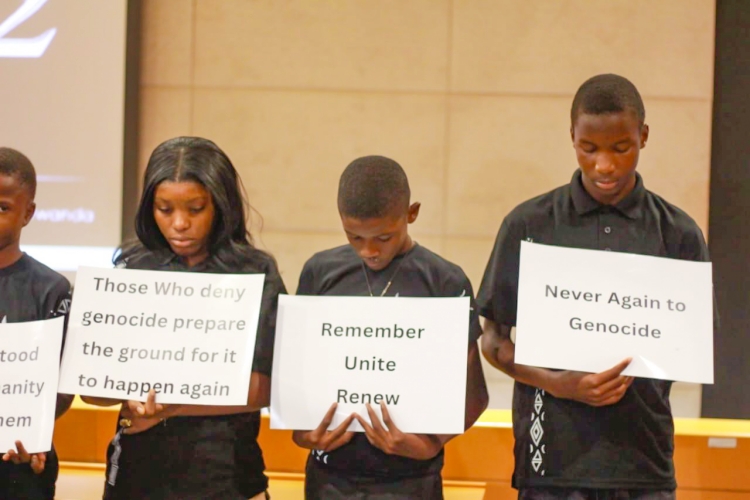
The commemoration concluded with a Kibuka32 exhibition showcasing messages of remembrance, resilience, and national renewal. The displays highlighted survivors’ stories, the importance of preserving historical truth, and Rwanda’s journey towards recovery following the genocide.
Children participating in the event also displayed messages such as “Genocide denial is complicity,” “Together against hatred,” and “The world must never forget,” reinforcing the call for remembrance and collective responsibility.
Kibuka, which means “to remember” in Kinyarwanda, is observed annually to honor the victims of the 1994 Genocide Against the Tutsi and to renew global commitments to preventing genocide and other mass atrocities.










Leave a Reply